Which air conditioner to choose: wall-mounted, ducted or picture-frame
Wall-mounted, ducted or picture-frame: it is a choice between price, silence, how visible the unit is, and how much renovation it drags along. We compare the three types on noise, efficiency, heating, ceiling height, installation and maintenance, suggest what to install in each room of a home, and show how to plan an air conditioner in FUTURIO Home.
Danylo Shevchenko, founder of FUTURIO
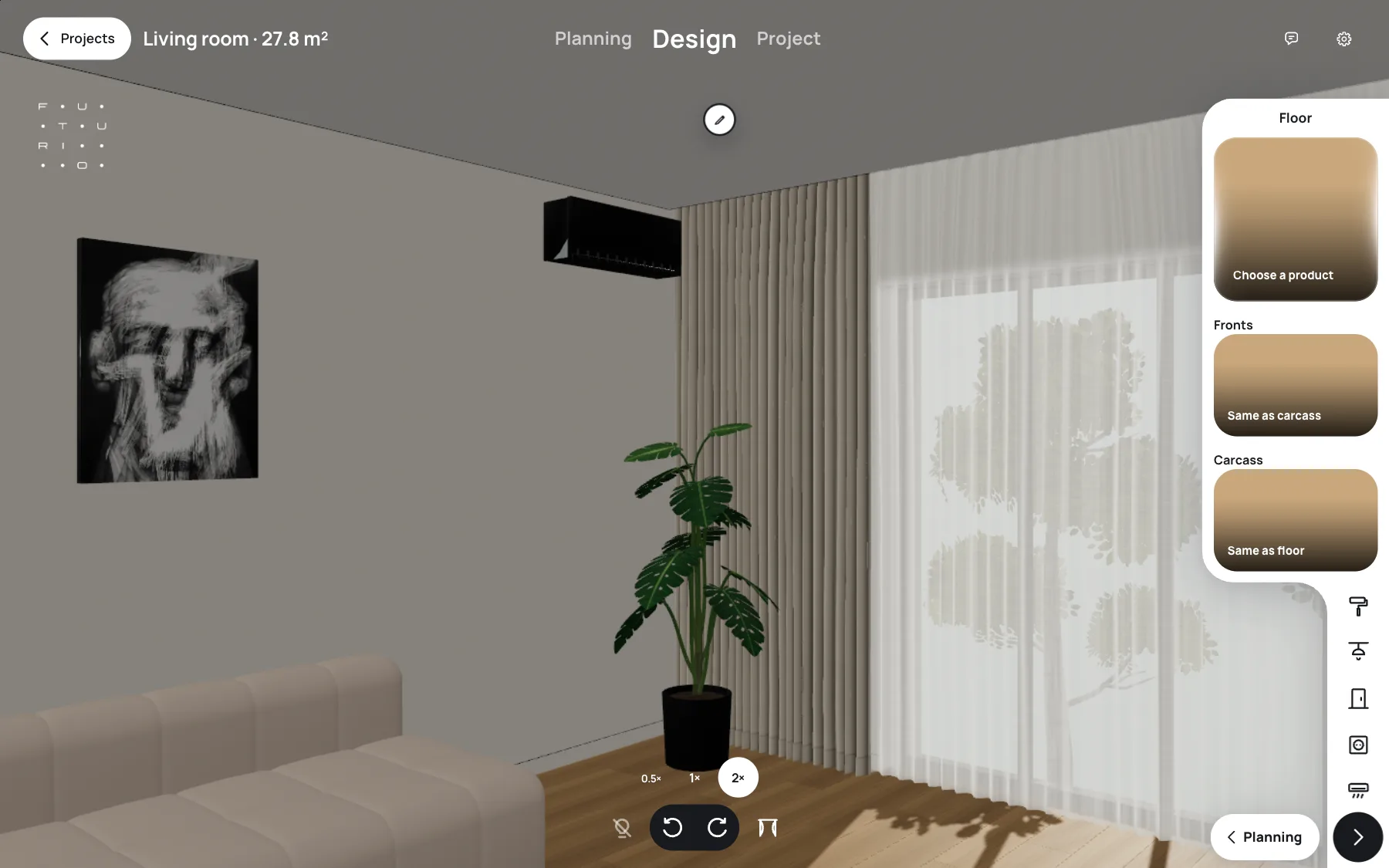
In short: where each air conditioner is strongest
A wall-mounted air conditioner is an ordinary wall split: the indoor unit hangs on the wall under the ceiling, the outdoor one on the facade or balcony. It is the most affordable, goes in within a day with no renovation, and is easy to maintain, but it is visible and the airflow comes from a single point.
A ducted air conditioner hides above the ceiling: the unit sits in a bulkhead over the corridor or above a wardrobe, and only narrow grilles come out into the room. It is the least noticeable and the quietest in the room and can serve several rooms, but it needs a dropped ceiling, a design and installation before finishing.
A picture-frame air conditioner is a designer wall unit in a square frame with a picture or a screen. It is hung in the middle of the wall like a painting, and the air leaves from the sides and the bottom of the frame. It is a compromise: installation almost like a wall-mounted unit, the look of an interior object, but the highest price among wall units.
One rule is common to every type: the line set, the drain and the power supply are laid before the final finishing. So the type of air conditioner is worth choosing together with the layout of the home, not after the renovation, when all that is left is a box on the wall. And no air conditioner replaces ventilation on its own: fresh air from outside can come only from a ducted unit with a fresh-air duct, and reliably only from a heat recovery ventilator.
In FUTURIO Home it works the same way: at the “Planning” stage you choose a wall-mounted or ducted air conditioner, the configurator looks for a safe place for it, and at the “Design” stage it shows models of the right capacity, including picture-frame units.
Wall-mounted means price and simplicity, ducted means invisibility and quiet, picture-frame means design without a dropped ceiling.
Pick an air conditioner by your own criteria
Mark what matters for your home and the list reorders. The first one is the type that best combines the chosen criteria; under each you can see where it is strong and where it falls short. Each criterion is covered in detail further down in the article.
- Wall-mounted air conditioner: affordable price — the most affordable; quiet in the room — quiet in night mode; invisibility and design — the unit is visible on the wall; winter heating — heats like a heat pump; installation without renovation — usually in a day; several rooms from one unit — one unit, one room; easy maintenance — filters come out by hand; no dropped ceiling — no ceiling drop; fresh air — recirculation only, some models a little
- Ducted air conditioner: affordable price — the most expensive, installation included; quiet in the room — the quietest in the room; invisibility and design — only the grilles are visible; winter heating — heats, but the warm air goes under the ceiling; installation without renovation — only together with a renovation; several rooms from one unit — one unit for several rooms; easy maintenance — through an access hatch; no dropped ceiling — needs a dropped ceiling; fresh air — with a fresh-air duct
- Picture-frame air conditioner: affordable price — the most expensive of the wall units; quiet in the room — like a good wall unit; invisibility and design — looks like a picture; winter heating — heating mode per the datasheet; installation without renovation — line set hidden in the wall; several rooms from one unit — one unit, one room; easy maintenance — filter behind the front panel; no dropped ceiling — needs a gap to the ceiling; fresh air — recirculation only
There is no perfect air conditioner: there is the best one for what matters to you.
Three air conditioners: what exactly you are choosing
All three are split systems: the indoor unit cools or heats the air in the home, while the outdoor unit with the compressor releases or takes up heat outside. Between them runs the line set: two copper pipes in thermal insulation, an inter-unit cable and a condensate drain. The difference is where the indoor unit stands and how the air gets into the room.
A wall-mounted air conditioner is an elongated unit, usually 70–100 cm wide, hung on a mounting plate under the ceiling. It takes air in at the top and blows it forward and down through louvres. The best place is on the wall next to the window or above the door: that way the airflow runs along the room instead of into your face.
A ducted air conditioner is a flat unit above the ceiling to which ducts are connected. It takes air from the room through a return grille and supplies cooled or heated air through one or several supply grilles. One unit can serve several neighbouring rooms if the ducts to them are short and an engineer has sized the supply correctly.
A picture-frame air conditioner is a wall unit in a square frame of about 65 × 65 cm: a picture, a photograph or a screen on the front, while the air is drawn in at the top and leaves to the left, right and bottom of the frame. It is hung like a painting, in the middle of a free wall, with clearances from the ceiling and neighbouring objects.
There are other indoor units too. A cassette unit is built into the ceiling behind a square panel and is more often used in offices and shops. A floor-ceiling unit hangs under the ceiling or stands near the floor, and it saves the day when there is no wall space. A multi-split is not a type of unit but a scheme: several indoor units, wall-mounted or ducted, on one outdoor unit, so you do not hang several boxes on the facade.
Site manager: A multi-split saves space on the facade, but every room depends on one compressor. If the outdoor unit stops, the whole home is left without air conditioning, so for two or three rooms compare it with separate split systems.

- Wall-mounted A unit under the ceiling on the wall by the window: it takes air in at the top and blows it forward and along the ceiling. The line set goes through the wall to the outdoor unit, and the drain runs with a slope to the trap.
- Ducted A unit in the ceiling bulkhead: air returns through the grille at the bottom and is supplied through the grille at the end of the bulkhead. A separate duct can take fresh air from outside, and the access hatch gives access to the filter and the drain pump.
- Picture-frame A frame at picture height: air is drawn in at the top and leaves to the sides and down along the wall. The line set and drain are hidden in the wall, so they are laid before plastering.
Wall-mounted and picture-frame units hang on the wall, the ducted one hides above the ceiling; a multi-split is several indoor units on one outdoor unit.
Noise: how many decibels you hear in the room and outside the window
An air conditioner’s datasheet gives two different numbers. The sound pressure level is what you hear in the room at about a metre away. The sound power level is a characteristic of the unit itself, and it is always higher. Compare models by the same figure and the same operating mode.
For a bedroom, the benchmark comes from the WHO: so that noise does not disturb sleep, the constant background in the room at night should not exceed 30 dB(A). Good inverter wall units in night mode are, by their datasheets, quieter than this limit, usually 19–25 dB(A) of sound pressure, and at maximum speed they give 35–45 dB(A). European ecodesign requirements limit the sound power of units up to 6 kW to 60 dB(A) for the indoor and 65 dB(A) for the outdoor unit.
A wall-mounted air conditioner makes noise where it hangs: it is quietest when the unit is not above the bed or the desk and the airflow runs along the room.
A ducted air conditioner is the quietest in the room because the unit itself sits behind the ceiling in the corridor or above a wardrobe. But the silence here depends on the design: grilles that are too small or ducts that are too narrow make the air whistle, so the airflow speed, silencers and duct cross-section are calculated by an engineer.
A picture-frame air conditioner sounds like a good wall unit, but it hangs lower and closer to people, at picture height. So it is better not to hang it right next to a sofa or a bed.
Site manager: Think about the outdoor unit together with your neighbours. Do not put it under someone else’s windows or bedrooms, fix it on vibration-damping mounts, and check the datasheet for the noise level of the outdoor unit, not only the indoor one.
For a bedroom, stay with night mode up to 25 dB(A); a ducted unit is the quietest in the room if its ducts are correctly sized.
Efficiency: SEER, SCOP and the inverter
The modern efficiency of an air conditioner is shown by seasonal coefficients under the European standard EN 14825. SEER is how much cooling the unit gives for each kilowatt-hour of electricity over the whole summer season. SCOP is the same for heating in winter. The higher the number, the lower the bills. The instantaneous EER and COP under standard EN 14511 describe only one operating point and say less about a real season.
On the European energy label for split systems, class A+++ for cooling means a SEER of 8.5 or more, A++ means 6.1 or more, A+ means 5.6 or more, and A means 5.1 or more. For heating in an average climate, A+++ starts at a SCOP of 5.1, A++ at 4.6, and A+ at 4.0. The minimum below which a unit of up to 6 kW may not be sold in the EU is a SEER of 4.6 and a SCOP of 3.8 for common refrigerants.
The inverter smoothly changes the compressor speed: after reaching the set temperature the unit does not switch off and start again but runs at low power. This is quieter, steadier in temperature and more economical than old on-off units. Today most household split systems are inverter ones.
Capacity is chosen by the volume of the room: a practical installers’ rule of thumb is about 30 W of cooling per cubic metre for a shaded room and up to 40 W for a sunny one. With a 2.7 m ceiling that is roughly 1 kW per 10 m². For a kitchen, add a margin for the heat from the cooker. An oversized unit does not make a room more comfortable: it cools quickly, switches the compressor off, dehumidifies the air worse and cycles more often.
Property developer: The efficiency class on the label is a simple argument for a buyer or a tenant. The difference between classes A and A++ in summer bills is noticeable already in the first season, while the price of the unit is a one-off.
Look at the seasonal SEER and SCOP, choose an inverter and size the capacity by volume, not “with a reserve”.
Winter heating: can you heat a home with an air conditioner
A split system in heating mode works as an air-to-air heat pump: it takes heat from the outside air and moves it into the home. For every kilowatt of electricity it delivers several kilowatts of heat, so in the shoulder seasons it is one of the cheapest ways to warm up an apartment.
The limit is frost. By the datasheets of common models, ordinary inverter units mostly heat down to about −15…−20 °C, cold-climate models down to −25 °C and below, but in the cold the output and SCOP fall. Look for the exact lower limit in the datasheet, and for cold regions look at the SCOP for a colder climate if the manufacturer states it.
A wall-mounted air conditioner heats most directly: the louvres send warm air down towards the floor. A picture-frame unit blows it sideways and downwards along the wall.
A ducted air conditioner supplies warm air from the ceiling, and warm air rises by itself. So for heating it matters that the supply and return grilles are laid out by calculation, otherwise the warmth will collect under the ceiling.
In winter the outdoor unit periodically defrosts and releases water. It needs a drain underneath so that ice does not build up on the pavement or on a neighbour’s balcony.
Site manager: An air conditioner is a good addition to heating, but not always a full replacement. If the home is heated only by it, underfloor heating in the bathroom and kitchen covers what warm air lacks: warmth underfoot.
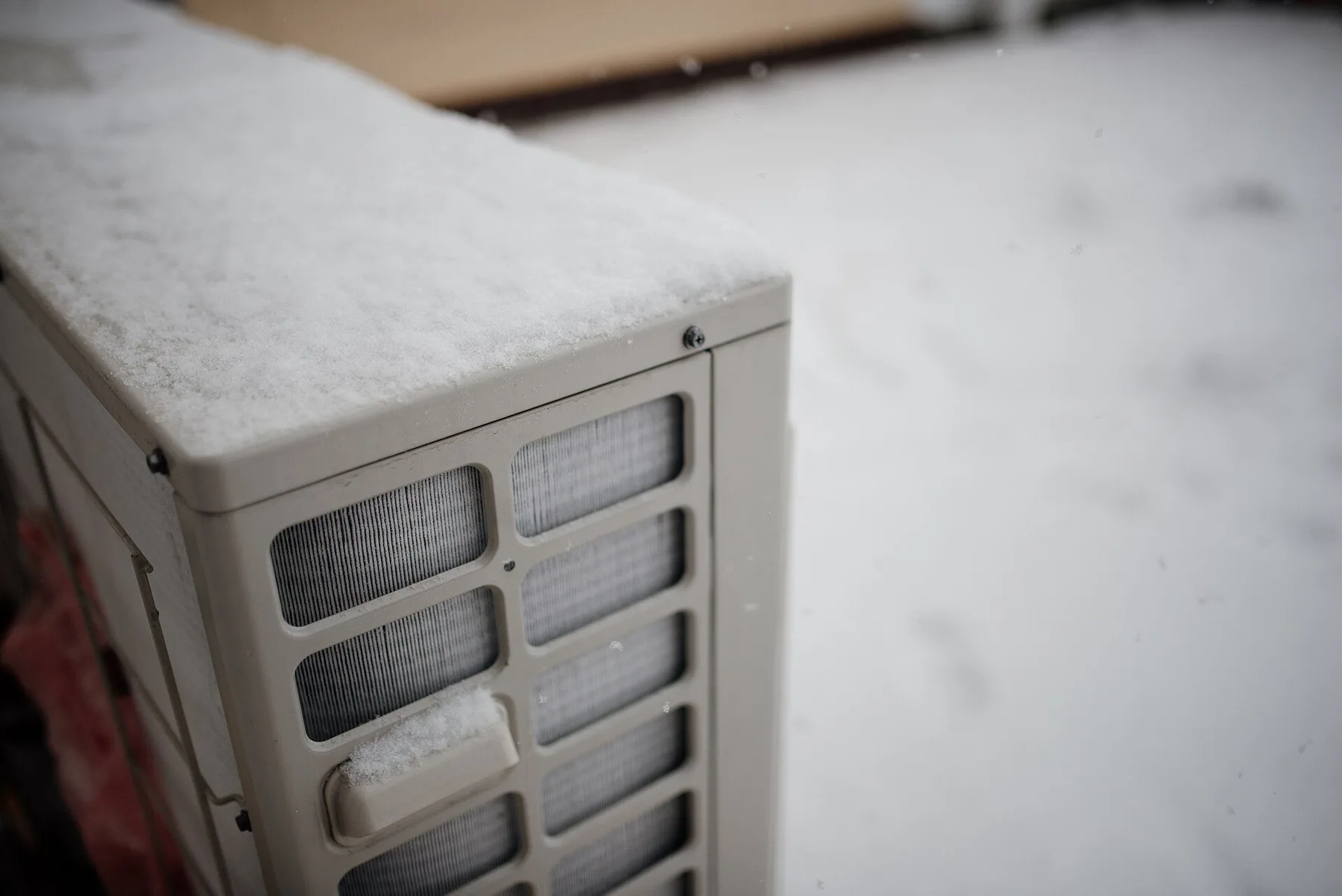
An air conditioner is an economical heat pump for the shoulder seasons; in hard frost its output drops, so check the lower limit in the datasheet.
Comfort: airflow, draughts and the position of the unit
The most common complaint about an air conditioner is not noise but a draught. A cold airflow aimed at a bed, sofa or desk quickly gives the feeling of catching a cold, even if the room is only 24 °C.
A wall-mounted air conditioner is placed so that the airflow runs along the room and above heads: on the wall next to the window or above the door, not opposite the bed. On modern models the louvres can be aimed upward, so the cold air spreads under the ceiling and slowly sinks.
A ducted air conditioner distributes air through several grilles, so the flow is softer and more even. Linear grilles by a wall or above a window give almost no sense of an airflow.
A picture-frame air conditioner blows air sideways and downwards along the wall. So it needs free wall to the sides of the frame and nothing in front that blocks the flow: wardrobes, shelves or a tall sofa pushed right up to it.
Interior designer: Do not chase a low temperature. A practical rule: it is comfortable when the room is 6–8 °C cooler than outside, not 15. That makes going out easier and lowers the risk of catching a cold.
Airflow along the room and above heads, not at the bed or the desk; ducted and picture-frame units give a softer flow.
Fresh air: an air conditioner does not replace ventilation
An air conditioner cools or heats the air that is already in the home but does not change it. In a closed bedroom overnight, two people exhale so much carbon dioxide that the air feels heavy in the morning even if the temperature is perfect. So fresh air is a separate question, and it is worth solving together with the choice of the air conditioner.
A wall-mounted air conditioner works on recirculation: it takes air from the room and returns it. Some models have an option to draw air from outside through a flexible hose and a separate opening in the wall, but that is a small share of the unit’s flow: it freshens the air but does not replace ventilation.
A ducted air conditioner can take fresh air from outside if it is built into the design: a fresh-air duct or a mixing box with a filter and a control damper is connected to the return side. Then the unit works part of the time with outdoor air, and its capacity is calculated with a margin, because in summer it has to cool, and in winter heat, this intake air as well.
A picture-frame air conditioner is recirculation too, just like the wall-mounted one: it adds no fresh air, so ventilation in the room is planned separately.
A heat recovery ventilator is a device that brings in fresh air from outside and at the same time extracts the stale air, transferring heat from one flow to the other. In winter it hardly chills the home, and in summer it does not bring in the heat. It can be installed separately in each room or built as a central system, often joined with a ducted air conditioner through shared ducts.
Carbon dioxide is the simplest measure of freshness. The European standard EN 16798-1 for a bedroom in the normal comfort category allows no more than 550 ppm above the outdoor level, that is, roughly up to 1000 ppm when it is about 420 outside. For the higher category the limit is 380 ppm above the outdoor level, for the minimum category 950. An inexpensive CO₂ sensor quickly shows whether airing is enough.
Site manager: If you are doing a major renovation and planning a ducted air conditioner, decide at once where the fresh air will come from: a fresh-air duct, a heat recovery ventilator or separate supply vents. An opening in the facade and a duct are much harder to add later, after finishing.
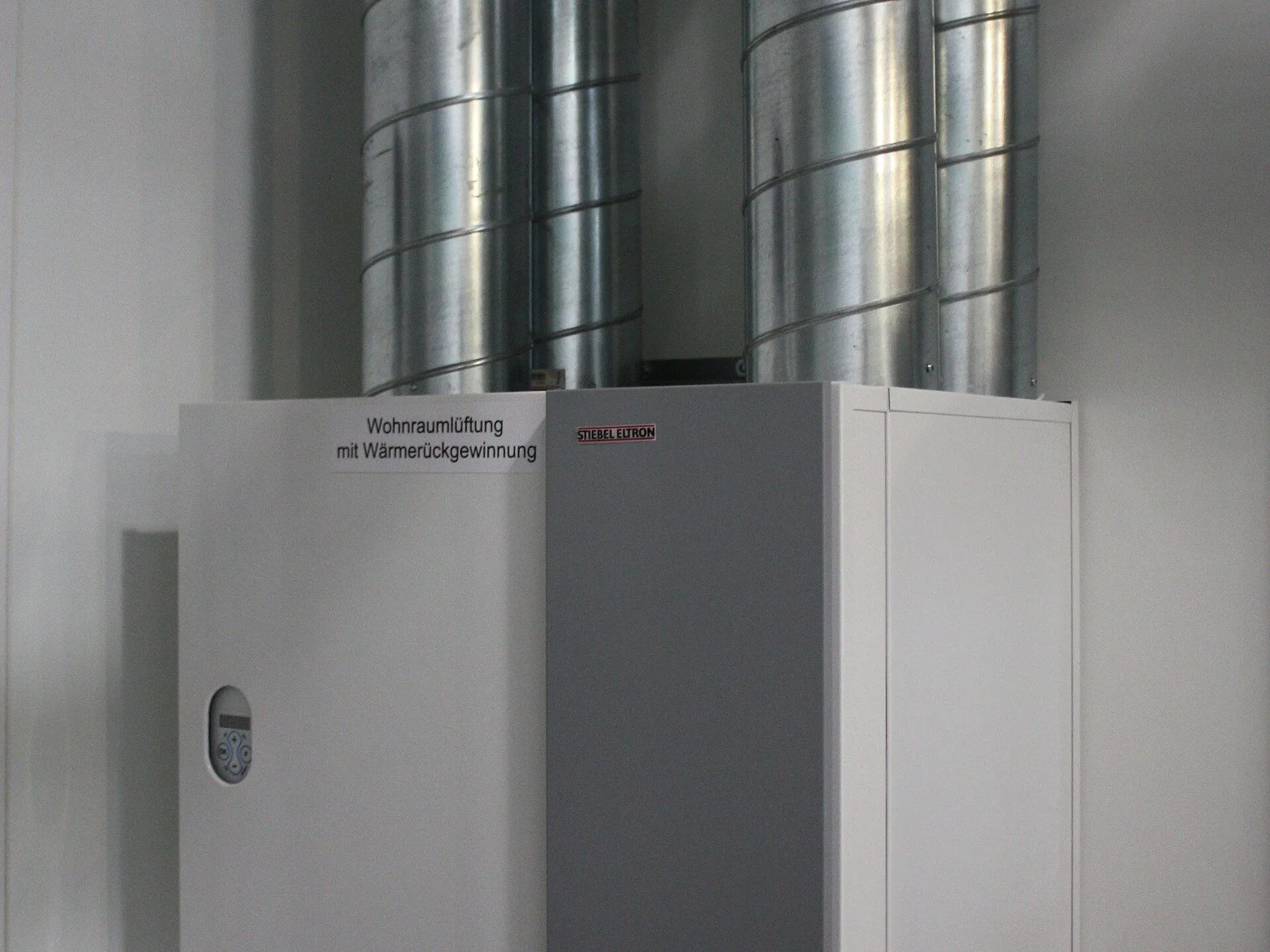
Wall-mounted and picture-frame units only stir the room’s air; a ducted one can bring in fresh air if it is built into the design, and real fresh air comes from ventilation or a heat recovery ventilator.
Ducted air conditioner and ceiling height
A ducted unit needs space above the ceiling. The thinnest household units are about 20 cm tall, and manufacturers require at least 24 cm of free space under the slab. Ducts, insulation and grilles are added to that, so in practice the ceiling is dropped by 25–35 cm where the unit sits.
That is why a ducted unit almost never sits above the middle of a living room. It is hidden where a low ceiling bothers nobody: in a bulkhead over the corridor, above a built-in wardrobe, in a box over the door or above the bathroom ceiling. In the room itself the ceiling stays full height, and only the grilles by the walls are visible.
An access hatch is essential under the unit, usually not smaller than 45 × 45 cm, to reach the filter, the drain pan and the control board. A unit sealed into drywall with no hatch is the most expensive mistake of a ducted system: the very first service begins with taking the ceiling apart.
Site manager: Show the bulkhead height and the position of the hatch and grilles on the ceiling drawing before the crew starts installing the frame. A duct that does not fit above the ceiling has to be rerouted, or the ceiling dropped lower than planned.
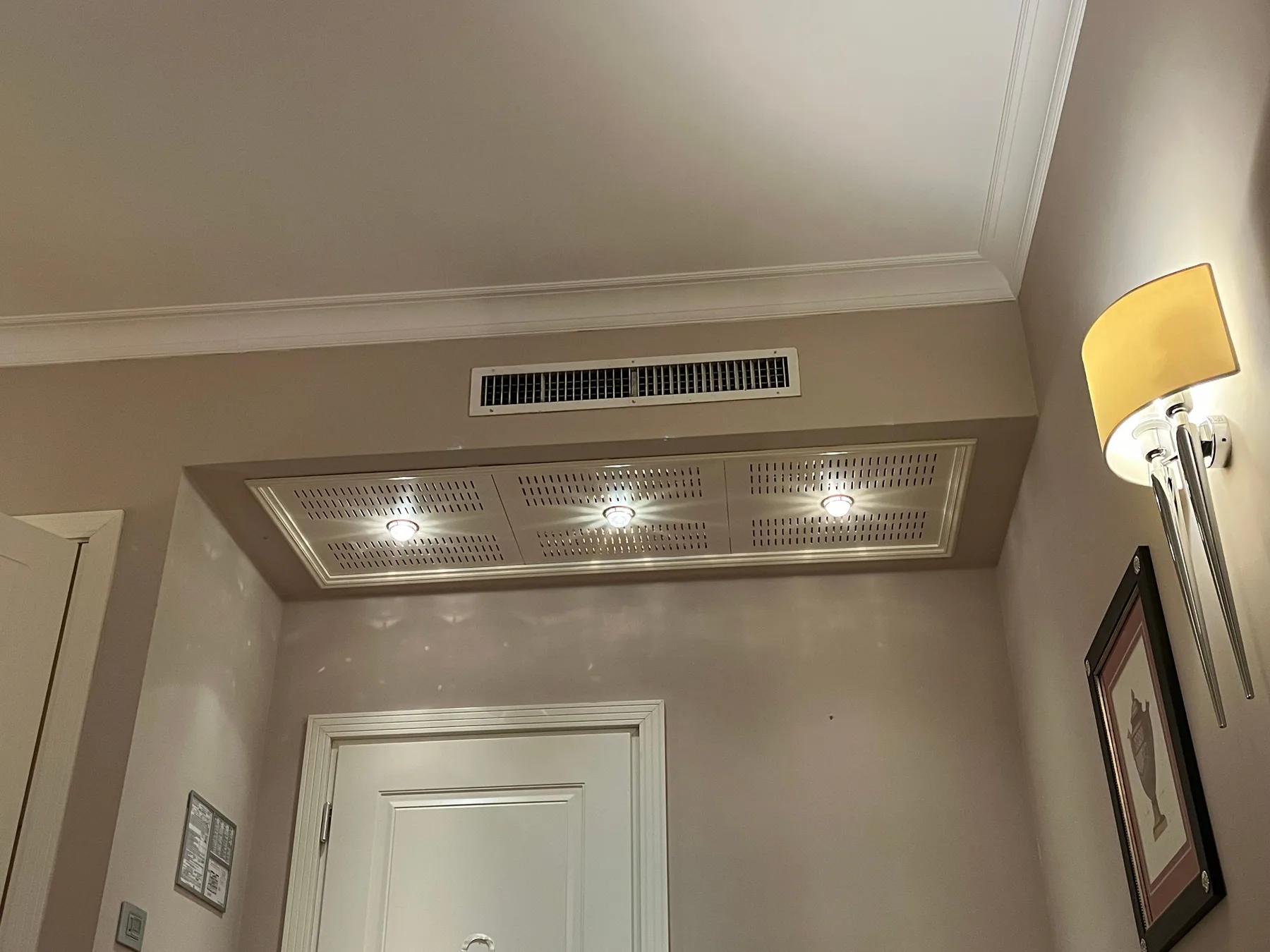
Ducted means a 25–35 cm drop in the corridor or above a wardrobe, an access hatch under the unit and a ceiling drawing before the frame is installed.
Installation and renovation order: the line set before finishing
In a renovation an air conditioner is installed in two stages. The first is at the rough stage together with the electrics: the insulated copper line set, the drain, the inter-unit cable and a separate power line from the panel are laid. The second is after painting: the indoor and outdoor units are hung, the line set is connected, the system is vacuumed, leak-tested and started.
A wall-mounted air conditioner can also be installed in a finished home, in a day, but then the line set runs along the wall in a decorative cover. If you want a clean wall, the line set is hidden in a chase before plastering.
A ducted air conditioner is possible only with a renovation: the unit and ducts are installed before the ceiling frame, and the grilles are fitted after finishing. It is a few days of work spread across the stages, and a design in which every grille already has its place.
A picture-frame air conditioner hangs in the middle of the wall, so the line set to it is almost always hidden in the wall: the opening comes out right behind the frame. It is the same first stage before plastering, only the exit point has to be known exactly, to the centimetre.
Most modern household split systems are charged with refrigerant R32. In the EU, installing and servicing split systems with fluorinated refrigerants must be done by certified specialists. And EU Regulation 2024/573 gradually bans new split systems with high global-warming-potential refrigerants: from 2025 for small single-split systems with a potential of 750 or more, from 2029 for air-to-air split systems up to 12 kW the limit is 150, and from 2035 such systems up to 12 kW must work without fluorinated gases, apart from exceptions for safety reasons.
Site manager: Bring out a separate power line with a breaker in the panel for each unit, and place the cable outlet next to the unit under the ceiling. In FUTURIO projects cables come from the ceiling and drop briefly to the appliances, so we do not put sockets under windows at all, and in our scheme the air conditioner is not powered from such a socket.
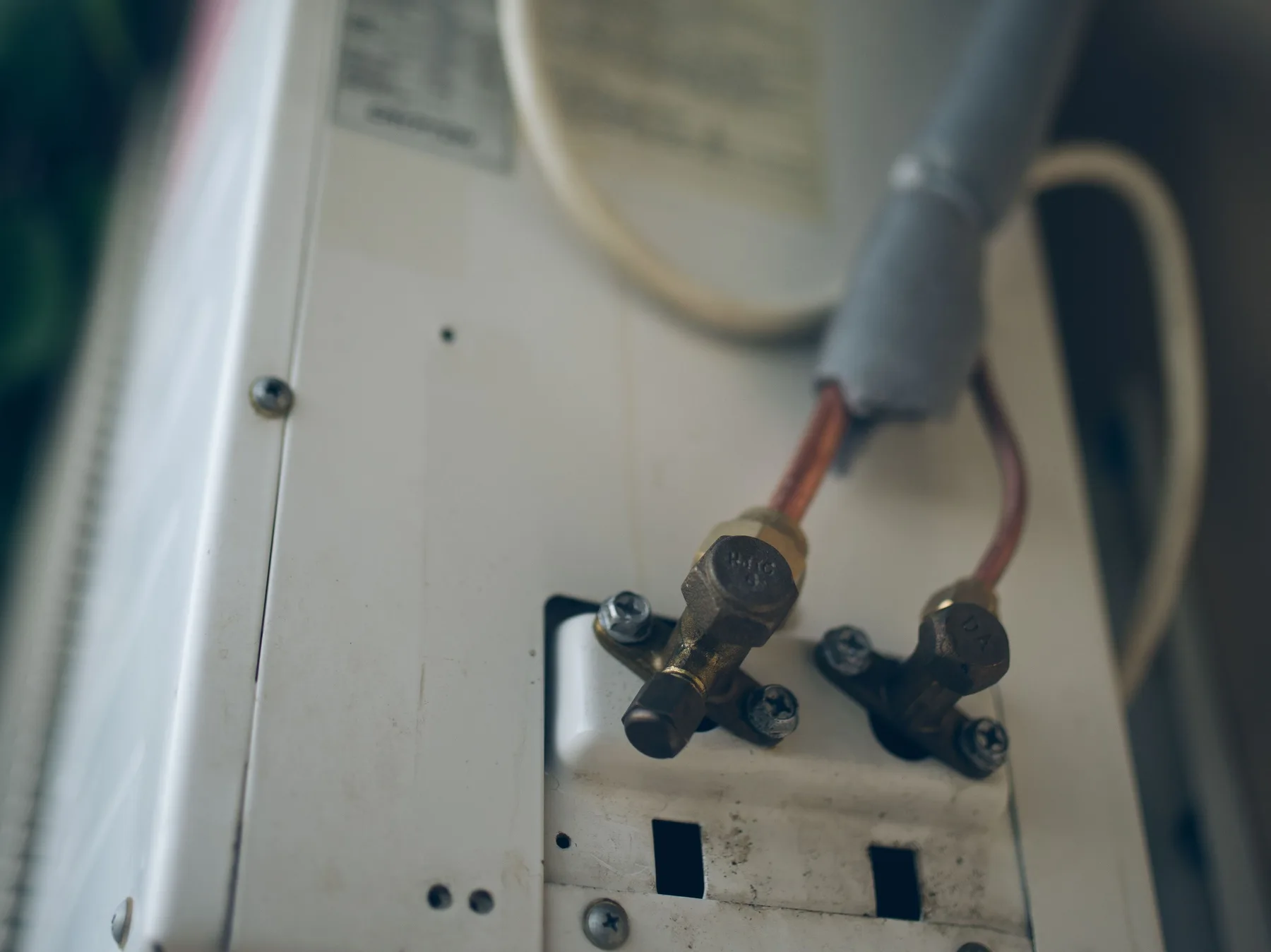
Line set, drain and power at the rough stage, units after painting; ducted and picture-frame units are not installed without a renovation.
Condensate drain: where to put the water
When cooling, the indoor unit dehumidifies the air, and in hot weather several litres of water can run out of it in a day. The drain tube is laid with a slope of at least 1 cm per metre so the water runs off by itself, with no reverse loops or sags.
It is best to run the drain into the sewer through a trap with a water seal or a dry trap that blocks odours. Discharging the water onto the facade, a window sill or a neighbour’s balcony is not allowed: it means streaks on the wall, ice in winter and complaints from neighbours and the building manager.
A ducted air conditioner sits above the ceiling, and a slope to the sewer does not always work out. Then a drain pump is fitted, often already built into the unit. The pump needs servicing, so access to it must be through the same access hatch.
Site manager: Check the drain slope with water before you close the chase. A bottle of water poured into the unit’s pan will show within a minute whether everything drains, and an open wall costs less than a wet stain on fresh paint.
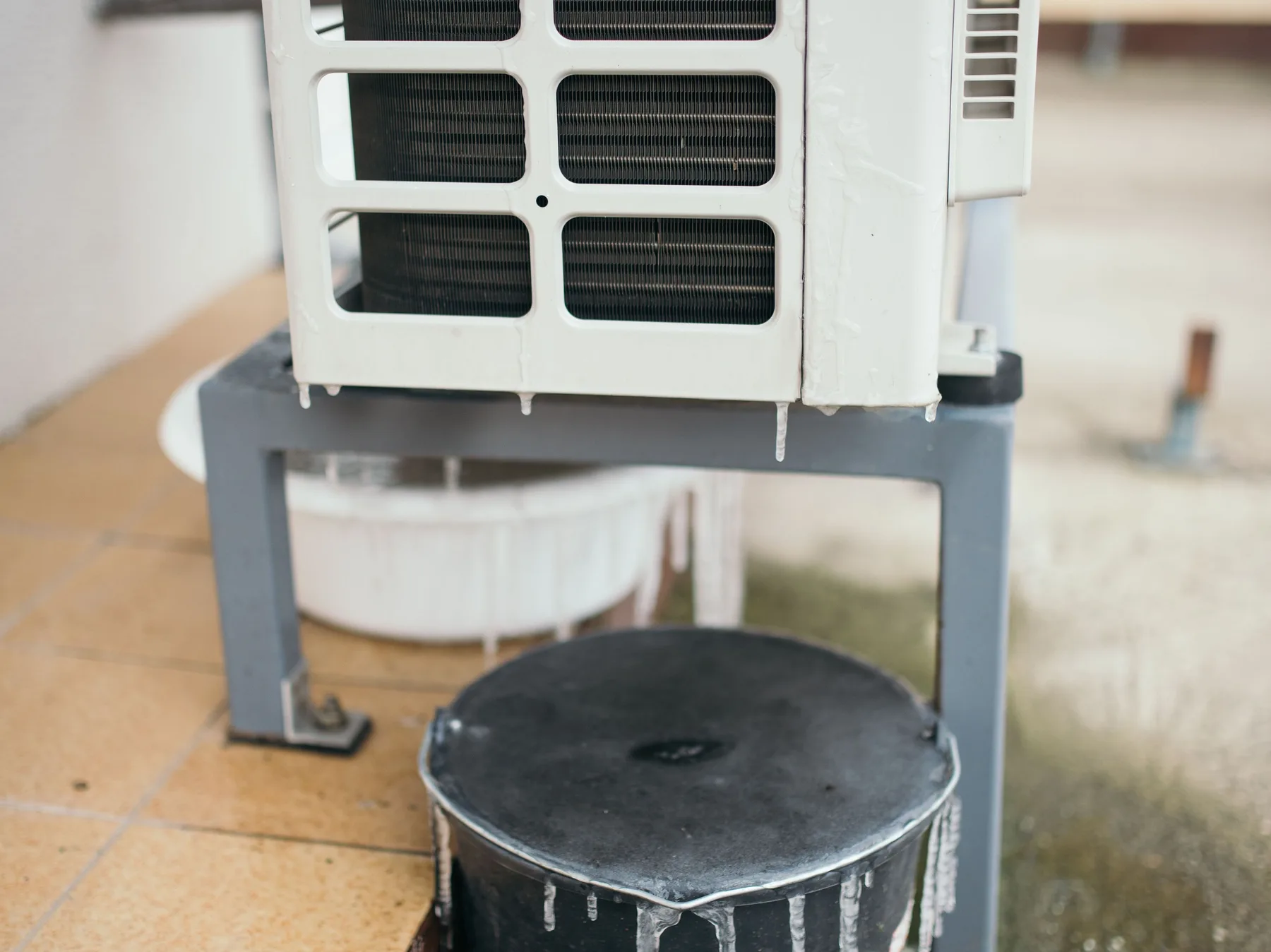
A slope of at least 1 cm per metre, the drain into the sewer through a trap, often a pump for the ducted unit; never onto the facade.
Outdoor unit: facade, balcony and building rules
The outdoor unit has to “breathe” freely: the manufacturer specifies clearances from walls and obstacles in the datasheet, and they must not be reduced. On a closed, glazed loggia with no ventilation the unit overheats, loses efficiency and can shut down on a fault.
The place on the facade is often governed by the city’s amenity rules and the decision of the building manager or the homeowners’ association: many buildings provide cages, niches or separate platforms for units, and historic facades have even stricter requirements. Before installation, find out the rules of your building.
The noise of the outdoor unit is heard by neighbours. Do not hang it under someone else’s window or on a wall behind which someone’s bedroom is, put it on vibration-damping mounts, and check the datasheet for the outdoor unit’s noise level and whether it has a quiet night mode.
Think about maintenance too: the outdoor unit must be reachable without industrial climbing, and the line set to it should be as short as possible. The limits on line-set length and height difference between the units are given in the datasheet of the specific model.
Property developer: In a new building, tidy cages for units on the facade and line sets already laid to every room are a visible argument at a viewing. The buyer does not have to chase into a fresh renovation and hang a unit wherever it fits.
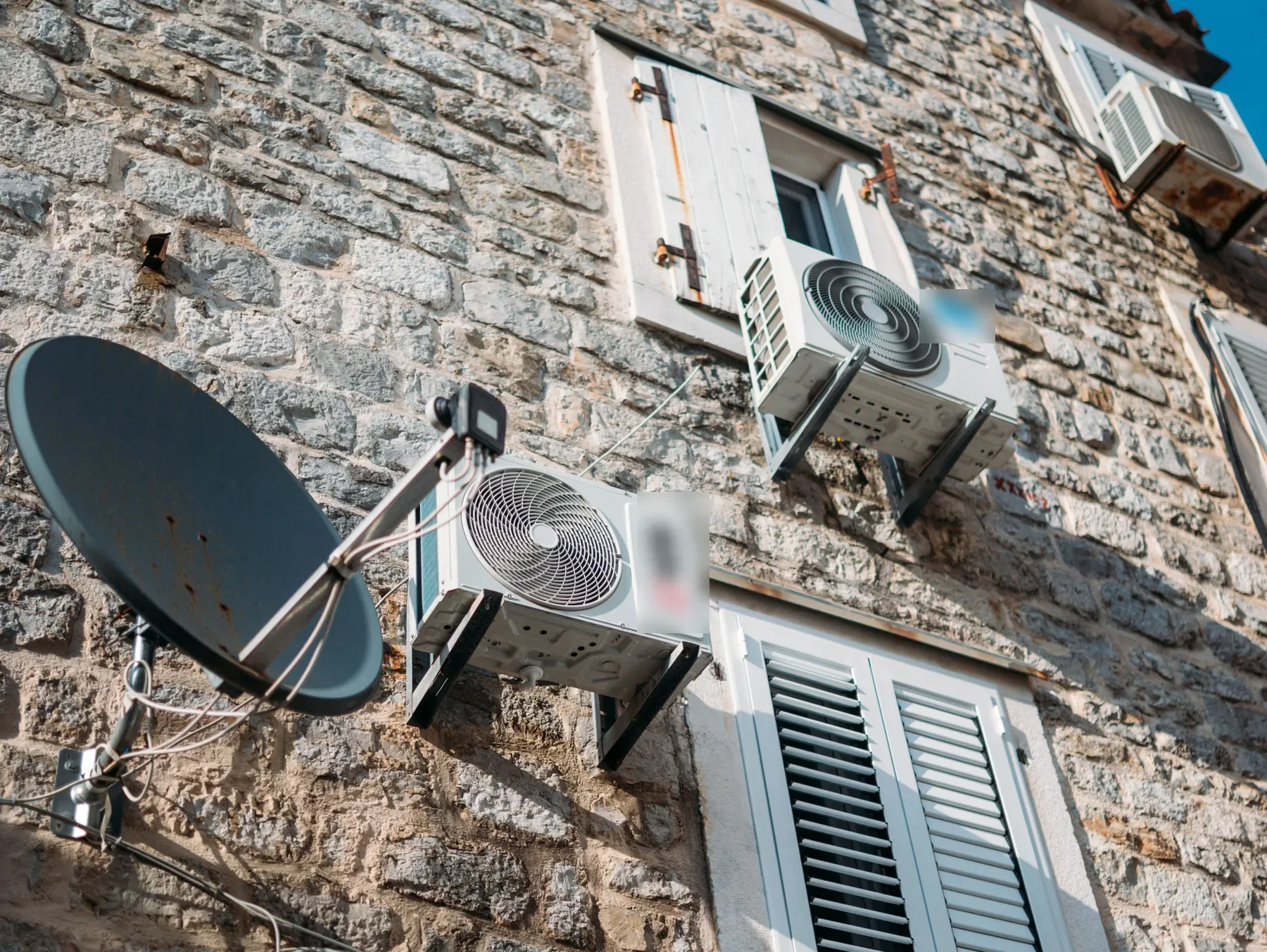
Clearances per the datasheet, place per the building rules, service access without climbers.
Maintenance: filters, service and access
A wall-mounted air conditioner is the easiest to maintain: the front panel flips open and the mesh filters come out by hand. In season most manuals advise washing them about once every two to four weeks; the exact interval is in the datasheet. Once a year a service technician cleans the heat exchanger and the drain and checks the system.
A ducted air conditioner is serviced through the access hatch and the return grille: there is often a filter behind it that is easy to reach. If the filter is only inside the unit itself, it cannot be reached without a hatch.
A picture-frame air conditioner is serviced like a wall unit: the filter is behind the front panel. But it hangs at eye level, so any streaks or dust on the frame are more noticeable than on a unit under the ceiling.
Site manager: A dirty filter means worse cooling, bigger bills and an unpleasant smell. Set a reminder on your phone for the season: ten minutes a month saves a technician’s call-out.
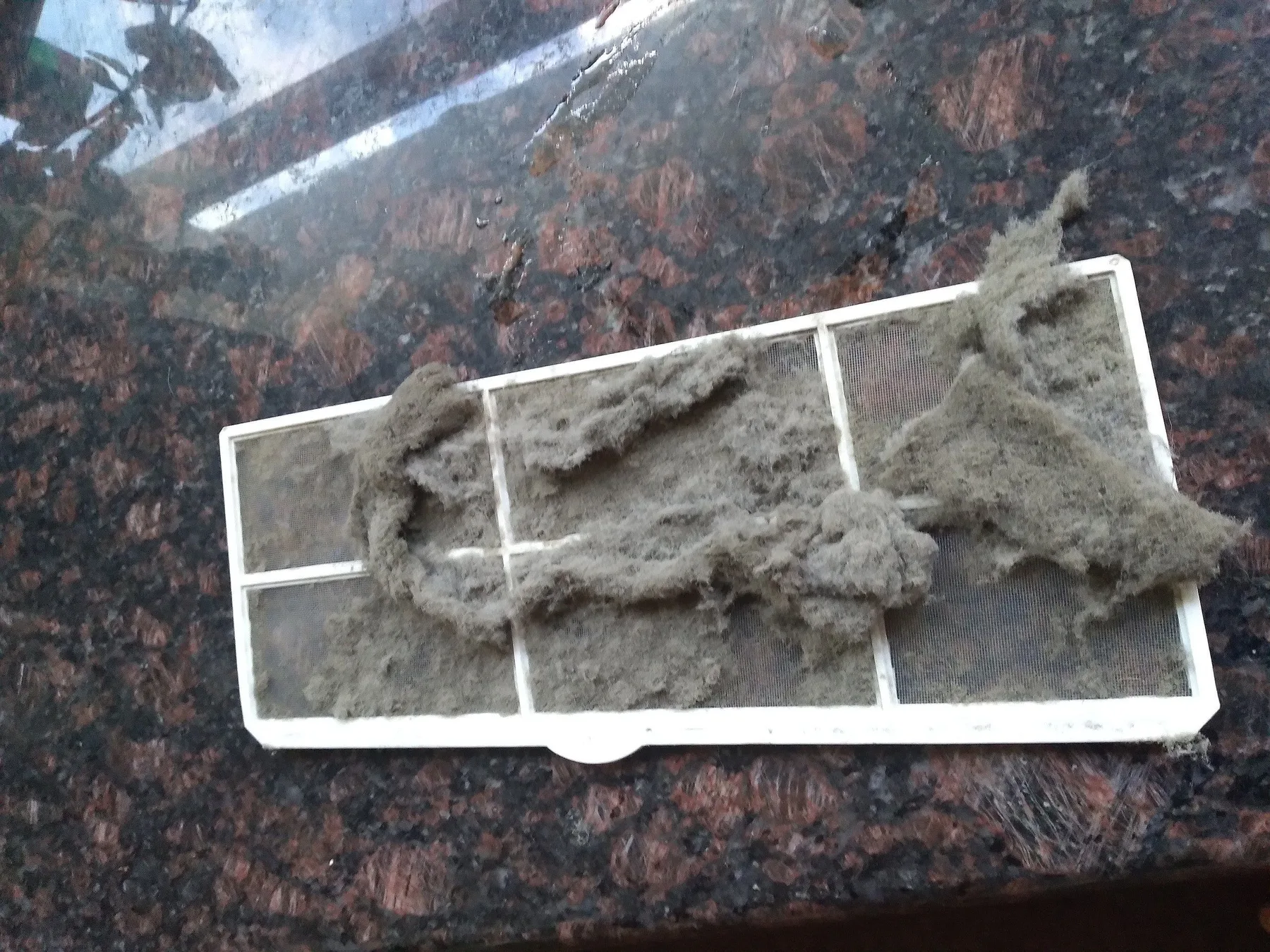
Filters every few weeks in season, service once a year; for a ducted unit the hatch is what matters.
Air conditioner and power outages
An inverter air conditioner starts smoothly, without the inrush current of old models. So a wall-mounted unit of 2.5 kW cooling that draws about 0.6–0.9 kW from the mains also runs from a power station or an inverter generator, provided their output covers the unit’s consumption with a margin and the voltage is a pure sine wave. Look up the exact consumption in the model’s datasheet.
The battery determines how many hours the coolness will last. A 1 kWh station in moderate mode gives roughly one to two hours of operation for one unit, so it usually cools one room, the bedroom, not the whole home. A ducted system serving several rooms consumes more, and on backup power it is best run only at minimum speed.
Voltage surges after the power returns are the main threat to the control board. A voltage monitoring relay on the air conditioner’s line in the panel cuts it off when the voltage goes out of range and switches it back on after a delay. It is an inexpensive module worth building in together with the separate line at the electrics stage.
Site manager: If you plan backup power, connect it to the panel through a changeover switch, not with an extension cord to a socket. Then the bedroom air conditioner, the refrigerator and the lighting get power from the station or the generator without moving cables around.
An inverter unit runs from a pure sine wave station or generator; a voltage relay in the panel protects the board when the power returns.
Price: what the budget depends on
The actual sums depend on the city, the model and the crew, so this is a comparison from renovation practice, not a price list. A wall-mounted air conditioner with standard installation is the most affordable option. A multi-split for several rooms is a mid-range budget. A picture-frame air conditioner is the most expensive among wall units. A ducted system with ducts, grilles and a ceiling drop is also at the top of the budget, but one unit can serve several rooms.
What affects the price of any air conditioner: capacity and energy efficiency class; line-set length and the difficulty of running it to the facade; a hidden line set in a chase or a cover on the wall; drain into the sewer or a pump; the mounting height of the outdoor unit.
The specifics of each type. For wall-mounted units, the price is moved by the SEER and SCOP class, a quiet night mode and the series. For ducted ones, by the design, the number of grilles and ducts, silencers and the ceiling drop with a hatch. For the picture-frame, by the unit itself and the accuracy of the hidden line set.
Property developer: A more expensive system does not always add more value. For a small home, several quiet wall-mounted units with hidden line sets are often better than a ducted system that takes ceiling height in the corridor.
Wall-mounted is the most affordable, multi-split is a mid-range budget, picture-frame and ducted are the most expensive; the price is moved most by the line set, the design and the efficiency class.
Comparison in one table
The scores are relative and general, drawn from renovation practice: the real result depends on the model, the design and the installer. The datasheet of a specific unit is always more important than a general table.
| Criterion | Wall-mounted | Ducted | Picture-frame |
|---|---|---|---|
| Price | the most affordable | high · including ducts | high |
| Where the indoor unit is | Under the ceiling on the wall | Above the ceiling | In the middle of the wall |
| What is visible in the room | The unit | Only the grilles | A frame with a picture |
| Noise in the room | Quiet in night mode | The quietest | Like a wall unit |
| Airflow | From a single point | Soft, several grilles | Sideways and down |
| Ceiling drop | 0 cm | ≈ 25–35 cm | 0 cm · gap to the ceiling |
| Several rooms | No · multi-split | Yes | No |
| Installation | Possible without a renovation | Only with a renovation | Line set in the wall |
| Maintenance | The simplest | Through a hatch | Like a wall unit |
| Drain | By gravity | Often a pump | By gravity |
| Fresh air | No · some models a little | Yes · with a fresh-air duct | No |
Choose by what matters most: budget and simplicity, invisibility and quiet, or design without a dropped ceiling.
Which air conditioner for which room
Bedroom. The main things are quiet and no airflow on the bed. A wall-mounted unit with a quiet night mode on the wall beside the bed, or a ducted grille above the window.
Living room. The biggest room of the home, where the unit is most noticeable. Here a ducted system with a bulkhead in the corridor or a picture-frame unit on a free wall works best. A wall-mounted unit suits too, if it is not the first thing you see from the sofa.
Kitchen. The cooker adds heat, and grease settles on the filters. A wall-mounted unit away from the cooker and the hood, with a capacity margin and more frequent filter cleaning.
Children’s room and home office. A wall-mounted unit, with the airflow not on the bed or the desk. For an office with video calls, a quiet mode matters.
The whole home. If a major renovation is planned and there is a corridor with a dropped ceiling, a ducted system for several rooms gives the cleanest interior. If not, separate wall-mounted units or a multi-split with hidden line sets.
Interior designer: Keep one style of units in one home, the same colour and shape. Different boxes in every room fragment the interior just as different floors do.
| Room | Best | Acceptable | Better avoided |
|---|---|---|---|
| Bedroom | Wall-mounted with night mode · ducted | Picture-frame away from the bed | Unit above the headboard |
| Living room | Ducted · picture-frame | Wall-mounted | Airflow onto the sofa |
| Kitchen | Wall-mounted | Ducted with filter access | Unit above the cooker |
| Children’s room | Wall-mounted | Ducted | Airflow onto the bed |
| Home office | Wall-mounted | Ducted · picture-frame | Airflow onto the desk |
| Whole home with a renovation | Ducted system | Multi-split | Line sets in covers along the walls |
Bedroom for quiet, living room for invisibility, kitchen for distance from the cooker; for a whole home with a renovation, a ducted system.
Mistakes that are expensive to fix
Deciding on the air conditioner after the renovation. Then the line set runs in a cover along a freshly finished wall, and a ducted system is no longer possible without taking the ceiling apart.
Taking the capacity “with a reserve”. An oversized unit switches on and off more often, dehumidifies the air worse and does not make a room more comfortable.
Hanging the unit opposite the bed or above the desk. A stream of cold air on a person is the main cause of complaints about air conditioners.
Sealing in a ducted unit without an access hatch. The very first cleaning of the filter or the pump begins with taking the ceiling apart.
Running the drain onto the facade. Streaks, ice in winter and a conflict with the neighbours and the building manager.
Powering the air conditioner from an ordinary socket under a window. An air conditioner needs a separate line with a breaker and an outlet next to the unit under the ceiling. In our scheme cables come from the ceiling, so there are no sockets under windows at all.
The air conditioner is planned together with the layout and the electrics, and then none of these mistakes has to be fixed.
How to plan an air conditioner in FUTURIO Home
At the “Planning” stage, open the “Air conditioner” group and choose “Wall-mounted” or “Ducted”. For a wall-mounted unit, specify the place: “Near window”, where the unit goes on a free wall adjacent to the window, under the ceiling, or “Above entrance”. The configurator checks the openings, projections, wardrobe and kitchen by itself, and if there is no safe place, it explains why. You can move the unit by hand, and the intersection check works then too.
A ducted air conditioner is offered by the configurator only where it can really be hidden: above a door next to which a wardrobe, a shelf or the kitchen adjoins through a partition, and where there is room for a 250 mm drop under the finished ceiling. Then a box with a grille appears above the door, and the drawings show the air conditioner box together with the wardrobe frame. If there is no such place, the “Ducted” option simply does not appear. The ducted unit itself and the ducts are selected by an engineer on site.
Choose the model of a wall-mounted air conditioner at the “Design” stage, in the “Air conditioner” group. The shop calculates the required capacity from the area and height of your room, adds a margin for the cooker in a kitchen, and shows models of a suitable capacity, while it does not offer ones that are too small or much too large.
A picture-frame air conditioner in the shop is a separate case: the configurator hangs such a frame in the middle of a free wall, its bottom no lower than 1.5 m, with at least 50 cm of free wall on each side and a gap to the ceiling of at least 20 cm. If the room has no such wall or the ceiling is too low, the model will not be accepted, and you will see an explanation.
For every air conditioner, the electrical plan gets a separate power outlet next to the unit, the ceiling lighting avoids its zone, and the unit goes into the drawings and the project specification, which you can hand to the crew. An honest limit: for now FUTURIO Home works room by room, so agree a multi-split for the whole home and the line sets to the outdoor unit with the installer from the drawings of each room. The configurator does not yet model ventilation, a heat recovery ventilator or a fresh-air duct; an engineer designs them separately.

Type and place at “Planning”, a model of the right capacity at “Design”, the power outlet and drawings automatically.
Frequently asked questions about air conditioners
Which air conditioner is the quietest?
In the room, a ducted one, because the unit itself stands behind the ceiling in another place and only grilles come out into the room. Among wall units, look at the night mode: the datasheets of good inverter models usually state 19–25 dB(A).
Which is better, a ducted or a wall-mounted air conditioner?
A ducted one is less noticeable, quieter and can serve several rooms, but it costs more, needs a dropped ceiling and is installed only together with a renovation. A wall-mounted one is cheaper, quicker to install and simpler to maintain.
What ceiling height does a ducted air conditioner need?
The thinnest units are about 20 cm tall and need at least 24 cm of space above the ceiling, and with ducts the ceiling is dropped by 25–35 cm. So the unit goes in a corridor, above a wardrobe or above a door, not in the middle of a room.
What is a picture-frame air conditioner?
It is a wall split in a square frame with a picture, a photograph or a screen on the front. It is hung in the middle of the wall at picture height, and the air leaves from the sides and the bottom of the frame, so free wall is needed next to it.
Can you heat an apartment with an air conditioner?
Yes, an inverter split system heats like a heat pump and is very economical in the shoulder seasons. In hard frost its output drops, so check the lowest operating temperature in the model’s datasheet.
When should the air conditioner line set be laid during a renovation?
At the rough stage, together with the electrics and before plastering: the copper line set, the drain, the inter-unit cable and a separate power line. The units themselves are hung after painting.
How often should an air conditioner be cleaned?
Filters in season about once every two to four weeks, and a full service cleaning with a system check once a year.
Does an air conditioner provide fresh air?
A wall-mounted and a picture-frame air conditioner only stir the room’s air; some wall-mounted models have a small intake through a hose. A ducted one can take air from outside if a fresh-air duct is built into the design. Truly fresh air comes from ventilation or a heat recovery ventilator.
What air conditioner capacity should I choose?
An installers’ rule of thumb is about 1 kW of cooling per 10 m² with a 2.7 m ceiling: less for a shaded room, more for a sunny one, with a margin for a kitchen. FUTURIO Home calculates this from the dimensions of your room and shows models of a suitable capacity.
The easiest way to feel the difference is to place a wall-mounted and a ducted air conditioner in your own room and see where they fit.
Verdict: choose the air conditioner together with the layout, not after the renovation
There is no perfect air conditioner. Wall-mounted means price, speed and simplicity, ducted means invisibility, quiet and several rooms from one unit, picture-frame means design without a dropped ceiling. And remember: fresh air comes from ventilation, not from an air conditioner; a ducted one can take over the intake only if it was built into the design. Decide what matters most to you before the rough work, and plan the line set, the drain, the power and the position of the outdoor unit for that type.
In FUTURIO Home you choose the type and place of the air conditioner in your own room, see whether it fits, and get a model of the right capacity, a power outlet and drawings for the crew.
Spotted an inaccuracy or want to suggest a new type of air conditioner? Write to us at hello@futurio.ua and we will correct the text.
Choose an air conditioner in your own room and see where it fits and what it drags along in the renovation.
Sources
- Regulation (EU) No 206/2012: ecodesign of air conditioners and fans
- Delegated Regulation (EU) No 626/2011: energy labelling of air conditioners
- Regulation (EU) 2024/573: fluorinated greenhouse gases
- EN 14825:2022: seasonal SEER and SCOP performance
- EN 14511-1:2022: air conditioners and heat pumps, terms and tests
- WHO: Guidelines for Community Noise (1999)
- European Commission: harmonised standards for air conditioners
- EN 16798-1:2019: indoor environmental parameters, including ventilation and CO₂
- REHVA Journal: the new CEN standard EN 16798-1 on health and comfort