Concrete, Stretch or Drywall Ceiling and Room Lighting
Choosing a concrete, stretch or drywall ceiling is a trade-off between height, quiet, budget, schedule and the lighting you will actually be able to install. We compare the three ceilings on soundproofing, eco-friendliness, cost and installation effort, then show which lighting suits each and how to put it all together in FUTURIO Home.
Danylo Shevchenko, founder of FUTURIO
In short: where each ceiling is strongest
A bare concrete ceiling is the cheapest and costs no height at all, but you must know the light positions in advance, and a bare slab amplifies echo in the room. A stretch ceiling is the fastest and cleanest to install: usually a day per room, with no plaster and no dust. Drywall is the slowest and messiest, but the most flexible in shape and has the greatest soundproofing potential if you build it as an acoustic system.
The ceiling also decides the lighting. On concrete: a chandelier or a magnetic track. A stretch ceiling adds “Halo light”, where the whole ceiling glows. Drywall allows built-in effects: FUTURIO’s own ceilings “Starry sky” and “Moonlight”, plus a track flush with the ceiling.
So the order of decisions is always the same: ceiling first, then lighting, then cables, and only then does the crew close the ceiling. FUTURIO Home works the same way: you pick the ceiling type, and the configurator shows only the lighting that can really be installed on it.
Concrete means height and savings, stretch means speed and cleanliness, drywall means quiet, shape and the most lighting options.
Pick a ceiling by your own criteria
Mark what matters for your room and the list reorders. The first one is the ceiling that best combines the chosen criteria; under each you can see where it is strong and where it falls short. Each criterion is covered in detail further down in the article.
- Concrete ceiling: affordable price — cheapest; soundproofing — as good as the slab itself; quick installation — fast if everything is planned; no dust or mess — dust from chases for cables; keep the height — no height lost; lighting options — chandelier or track; leak protection — water runs along the slab; eco-friendliness — minimum of materials
- Stretch ceiling: affordable price — mid-range, luminous costs more; soundproofing — adds almost nothing; quick installation — usually within a day; no dust or mess — almost no mess; keep the height — about 10 cm lost; lighting options — “Halo light”, chandelier, track; leak protection — the sheet holds the water; eco-friendliness — PVC or fabric: ask for certificates
- Drywall ceiling: affordable price — mid-range to the most expensive; soundproofing — best, with mineral wool; quick installation — longest installation; no dust or mess — filler and sanding; keep the height — 10 cm lost or more; lighting options — “Starry sky”, “Moonlight”, chandelier, track; leak protection — the wet section is replaced; eco-friendliness — mineral base, recyclable
Three ceilings: what exactly you are choosing
A concrete ceiling is the floor slab as it is in a new building: no suspended structure. It is cleaned, dedusted and primed, and the lights are fixed straight to the slab. The clear room height equals the height up to the slab.
A stretch ceiling is a sheet stretched over profiles around the perimeter of the room. The most common sheets are PVC film, installed with the room heated; there are also fabric sheets that are stretched without heat. A void remains between the sheet and the slab for cables, mounting plates for fixtures and LED strips.
A drywall ceiling is a metal frame on hangers, clad in plasterboard, skimmed and painted. It is the same void overhead, but with a rigid surface into which you can cut lighting of any shape and hide curtain recesses. If quiet matters to you, soundproofing mineral wool goes between the frame profiles before the boards are fixed. It is an inexpensive step that you cannot add later without taking the ceiling apart.
Site manager: Stretch and drywall ceilings always take away height. FUTURIO Home assumes a 10 cm drop for both, which is enough for cables, fixings and built-in profiles. A concrete ceiling has no drop, and the room height, chandelier drops and drawings are all calculated from the slab.
Concrete: no drop. Stretch and drywall: about 10 cm less, but with room for cables and built-in light.
Soundproofing: what each ceiling really gives you
First, a distinction. Soundproofing is how much noise gets through from the neighbours above. Room acoustics is how sound bounces around inside the room: echo and the hum of voices. The ceiling affects both, but in different ways.
Concrete ceiling. The massive slab itself provides the main soundproofing between floors, and a bare ceiling does not make it worse, but it does not add anything either. A hard bare surface reflects sound, so a room with little textile has a more noticeable echo. Rugs, curtains, soft furniture and open bookshelves dampen it.
Stretch ceiling. A thin sheet adds almost no soundproofing by itself. Mineral wool in the void above the sheet helps a little. There are special perforated sheets with an absorber above them for room acoustics, but an ordinary gloss or matt sheet reflects sound.
Drywall ceiling. The greatest potential of the three, if you build it as an acoustic system: mineral wool in the void, vibration-isolating hangers instead of rigid ones, and an airtight junction with the walls. Such a ceiling noticeably muffles airborne noise from neighbours. Ordinary drywall without wool on rigid hangers gives much less.
Site manager: Footsteps and impacts from above are best damped by a floating screed on the neighbours’ floor, and a ceiling below helps only partly. If quiet is your priority, plan the acoustic ceiling at the budget stage: afterwards you would have to take a finished one apart.
For quiet, drywall with mineral wool on vibration-isolating hangers works best. Concrete and stretch ceilings add no soundproofing on their own.
Eco-friendliness: materials, smell, dust and recycling
Concrete ceiling. The fewest new materials and the least waste, because you use what is already there. But bare concrete is dusty, so it must be dedusted and primed, preferably with a water-based product. The main source of dust here is chasing cable channels.
Stretch ceiling. PVC film is a plastic with plasticisers. Manufacturers declare quality sheets as phthalate-free and back that with low-emission certificates for indoor air. A fresh sheet may smell for the first few days, so ventilate the room and ask the installers for certificates for the specific sheet. Recycling PVC film is technically possible but in practice not available everywhere. Fabric sheets need no heating during installation.
Drywall ceiling. Gypsum is a mineral material, its core does not burn, and plasterboard waste can be recycled into new board where collection exists. The environmental weak points are the filler, primer and paint, so choose a paint with low volatile organic compounds. And of the three options, sanding the joints produces the most dust.
Site manager: Sand drywall with a sander connected to a vacuum, and cover everything already standing in the flat with film. Fine gypsum dust settles everywhere and takes weeks to clear.
Concrete uses the least material, drywall has a mineral, recyclable base, stretch is plastic, so ask for the sheet’s certificates.
Cost: the $ scale and what drives it
Actual sums depend on the city, the crew and the condition of the slab, so this is a relative scale from renovation practice, not a quotation. A concrete ceiling is $ if the slab is level. A single-level matt stretch ceiling with a few fixtures is $. Single-level painted drywall is $; multi-level drywall with recesses and built-in light is $$. A luminous stretch ceiling is also $$: it needs a special sheet, strips and power supplies.
What drives the cost of any ceiling: the area; the perimeter and the number of corners, columns and pipe bypasses; the number of light points and lines, since each needs a mounting plate, profile or cut-out; the type of wall junction (standard, shadow gap or “floating”); the number of levels and curtain recesses; and the room height, because above a certain height you need scaffolding.
What is specific to each type. For concrete, the cost is set by the state of the slab: grinding, filling level differences and priming, plus chases for cables. For stretch, it is the sheet type (matt, satin, gloss, fabric or translucent for a luminous ceiling), the room width if the sheet has to be welded with a seam, and the profiles for a track or light lines. For drywall, it is the number of coats of filler, the paint class, access hatches and mineral wool if you need soundproofing.
Property developer: A more expensive ceiling does not always add more value. But buyers and tenants remember a room by its light, so one expressive ceiling in the living room or bedroom often works better than elaborate ceilings in every room.
Concrete is $, stretch is $, drywall runs from $ to $$. Perimeter, amount of lighting, levels and finish move the cost the most.
Installation effort: crews, timing, mess and height
Concrete ceiling. The least work: cleaning, dedusting, priming and an electrician. But it is the most demanding option for planning: the cable comes out at a specific point, and moving it later means a new chase. No height is lost.
Stretch ceiling. One specialist crew, usually one day per room, almost no mess and no wet processes. It goes in as one of the last jobs, when the walls are finished and all mounting plates for lights are in place. Height: FUTURIO Home assumes 10 cm.
Drywall ceiling. The longest process and several trades: frame, boarding, joint reinforcement, filler, sanding, primer and paint, with pauses for drying. If you rush, or do not ventilate and heat the room, cracks appear at the joints. The height loss is the same 10 cm, and more for multi-level ceilings.
Site manager: Before the rough work, you need to know the ceiling type and the finished-ceiling level, the chandelier points and track lines, the built-in wardrobe zones above which no lights go, and the power supply locations with access to them. Give the crew the ceiling and lighting drawings together with the furniture layout, and the electrician will not have to ask where the table will be.
Stretch is the fastest, drywall the longest, concrete the simplest to build but the most demanding to plan.
The comparison in one table
The ratings are relative and generalised from renovation practice: the real result depends on the slab, the materials and the crew.
| Criterion | Concrete | Stretch | Drywall |
|---|---|---|---|
| Cost | $ | $ · luminous $$ | $ · complex $$ |
| Soundproofing | As the slab itself | Adds almost nothing | Best · with mineral wool |
| Echo in the room | More noticeable | Like an ordinary ceiling | Less with acoustic panels |
| Eco-friendliness | Minimum of materials | PVC or fabric · ask for certificates | Mineral base · recyclable |
| Installation effort | Low | Low | High |
| Mess and dust | Dust from chases | Almost no mess | Filler · sanding |
| Timing | Quick | Usually a day | Longest |
| Height lost | 0 cm | ≈ 10 cm | ≈ 10 cm or more |
| Leak from above | Water runs along the slab | The sheet holds the water | The section is replaced |
| Lighting in FUTURIO Home | Chandelier · Track | Halo light · Chandelier · Track | Starry sky · Moonlight · Chandelier · Track |
Choose by what matters most to you: height and budget, speed and cleanliness, or quiet and lighting options.
Which lighting suits which ceiling
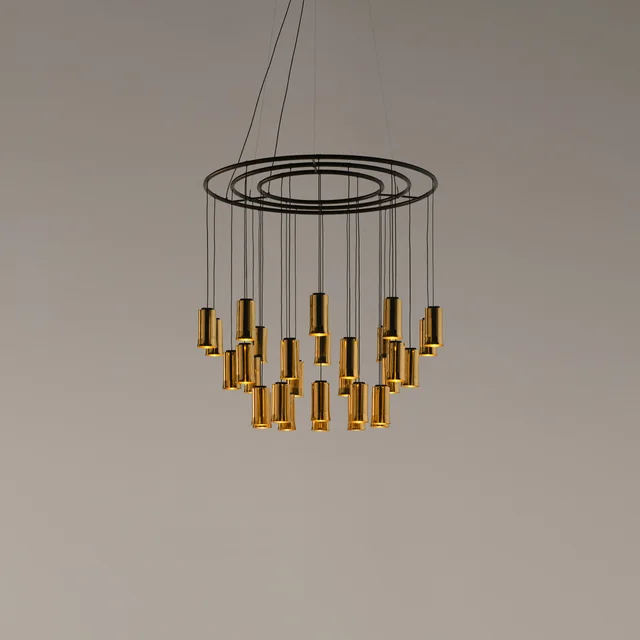
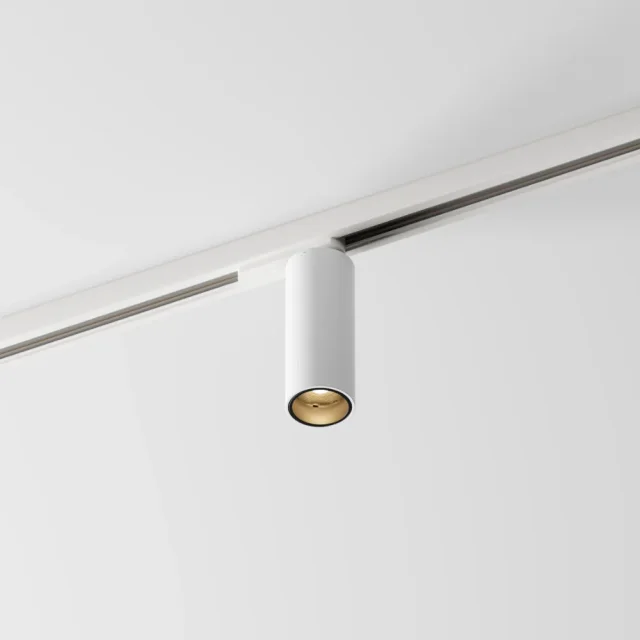
A chandelier and a magnetic track suit all three ceilings; only the way they are fixed changes. The other options are tied to the construction: a luminous stretch ceiling is possible only under a sheet, and built-in lighting effects only in drywall, which has a rigid surface and a void behind it.
Interior designer: Think not of a single fixture but of scenes: bright general light for cleaning, warm local light over the table or sofa, and soft night light for the bedroom. One ceiling rarely covers all three, so a chandelier or track is often combined with built-in light.
 Halo light
 Moonlight
 Starry sky
 Chandelier
 Magnetic track
Chandelier and track go on any ceiling; a luminous ceiling goes under a sheet; built-in effects go in drywall.
Concrete ceiling: chandelier or magnetic track
A chandelier on concrete is fixed straight to the slab. It is the simplest way to give a room its main light, and the chandelier itself becomes an accent against the raw texture. A magnetic track is installed as a surface-mounted profile on the slab, or hung on cables 30, 50, 80 or 100 cm long to lower the light closer to the table or sofa.
Why this way: concrete has no void, so built-in light is impossible. A track gives what a single chandelier lacks, several directional fixtures that can be rearranged without an electrician. For a bare slab FUTURIO Home does not offer a ceiling colour: concrete stays concrete, and white or black fixtures become a graphic accent.
Site manager: On concrete, set the cable outlet point for a chandelier or track from the drawing before chasing, not on the spot.
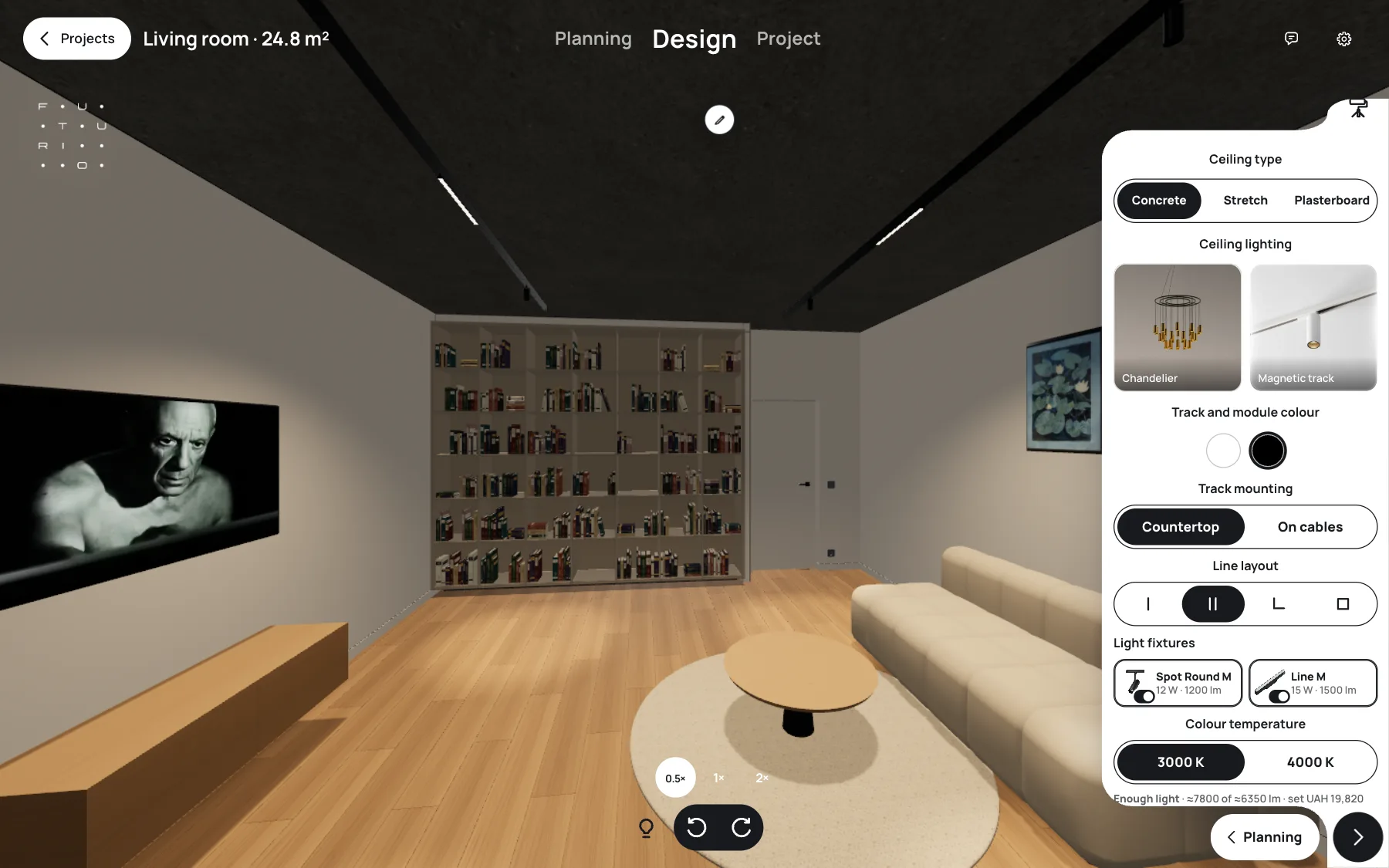
Concrete means a chandelier or a track: no height lost and light you can rearrange.
Stretch ceiling: “Halo light”, a chandelier and a track on a platform
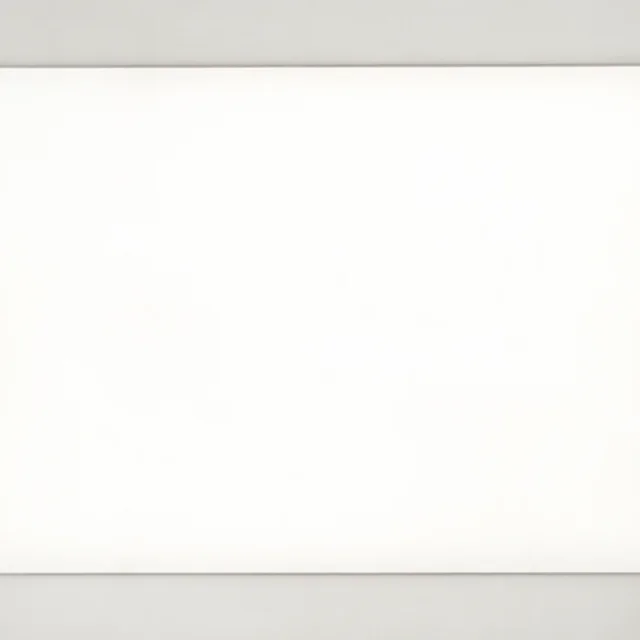
“Halo light” is a luminous stretch ceiling: LED strips are hidden above a translucent sheet, and the whole plane glows evenly, with no shadows from individual fixtures. It is the softest general light possible and a good choice for low rooms where a chandelier would hang over your head.
The configurator calculates how many strip lines are needed and at what pitch to lay them so the sheet glows without stripes, taking into account the area, the height and the colours of the walls, ceiling and floor. You choose the white light temperature, from warm to cool.
An LED strip lasts a long time, but not forever. So for “Halo light” it is worth planning a spare line right away: a second strip is laid next to the main one and run to the power supply, but not connected. If the main line ever goes out, switching the power over is easier than removing and restretching the sheet.
A chandelier on a stretch ceiling is fixed to a mounting plate under the sheet, and a magnetic track sits flush with the sheet on a hidden platform or hangs on cables.
Site manager: For a luminous ceiling, hire a crew that has already done luminous sheets, and agree the strip pitch with them before installation. Mounting plates for a chandelier are set from the drawing: after the sheet is stretched, the point can no longer be moved.
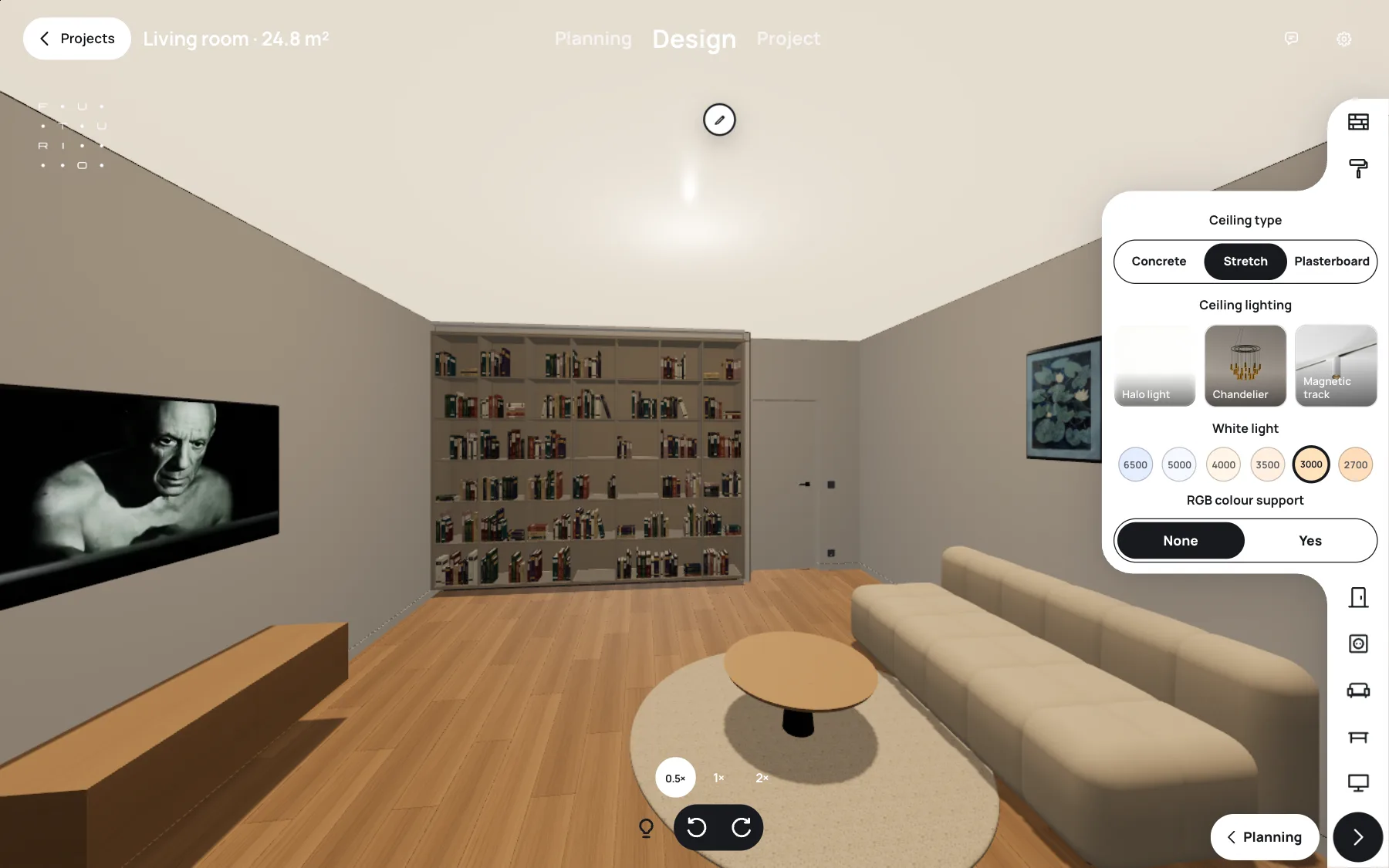
A stretch ceiling gives the most even general light, and FUTURIO Home does the strip calculation for you.
Drywall: “Starry sky” and “Moonlight”, FUTURIO’s own ceilings
Drywall opens up built-in light, and here FUTURIO offers two ceilings of its own design. Neither has any fixture hanging down, so they suit low rooms too, where a chandelier would hang too low.
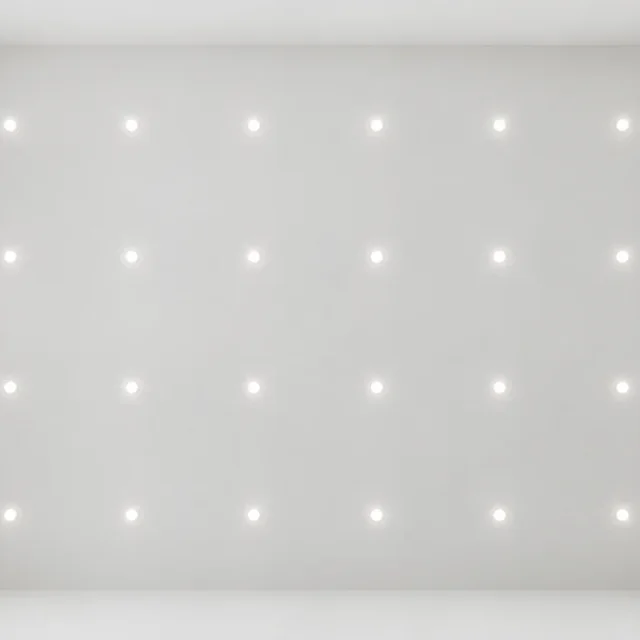
“Starry sky” is small points of light evenly spaced across the ceiling. The standard grid gives calm, diffused light; the dense one adds up to several hundred smaller points and the feeling of a real night sky. In a bedroom it is the softest night light: you can walk to the door without switching on the main light. You choose the ceiling colour (white, black or the wall colour) and the colour of the points (white or black) separately, and no points are placed above built-in wardrobe zones.
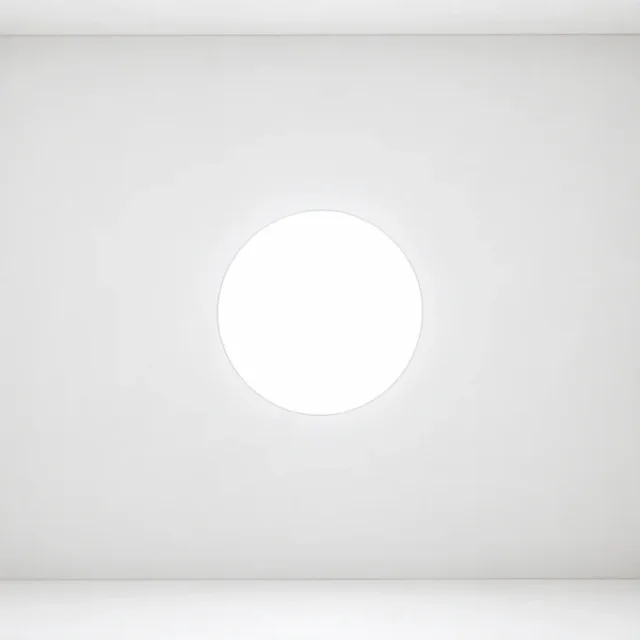
“Moonlight” is a large circle of light set flush with the ceiling: 1200, 1600 or 2000 mm in diameter in the living room and bedroom. It gives even, calm light and becomes the centre of the room with no visible fitting. The configurator shows only the diameters that fit in the free area of the ceiling with a margin from the edges, taking into account the built-in wardrobe and the feature wall. This option is available for rectangular rooms.
Interior designer: Put the large circle above the area where people gather, the sofa or the table, and combine it with a table lamp or bedside pendants for reading.
Property developer: Such a ceiling is memorable from the first frame, both in listing photos and for guests.
Site manager: If you have noisy neighbours above, ask for soundproofing mineral wool to be put between the profiles before boarding, and for “Moonlight” and “Halo light” plan a spare LED strip line. It is laid and run to the power supply together with the main one: if the main one ever fails, the electrician simply switches the power over without removing the sheet.
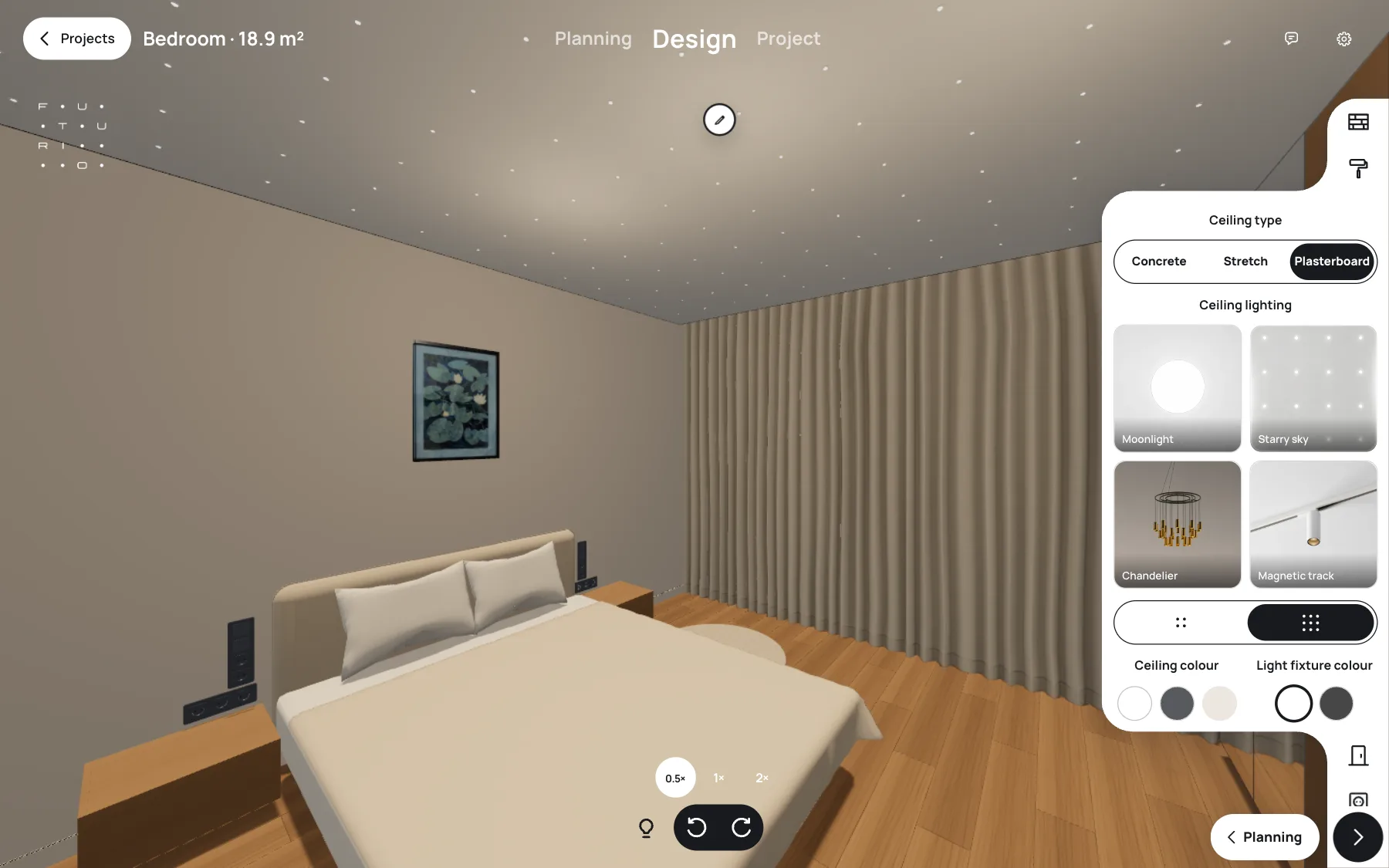
For atmospheric light with no visible fixtures, choose drywall and FUTURIO’s own “Starry sky” or “Moonlight” ceilings.
How the authored lighting looks in the drawings
A luminous ceiling or a circle in the ceiling depends on exact figures, and the crew should not have to guess them on site. So for “Halo light”, “Starry sky” and “Moonlight”, FUTURIO Home draws separate sheets: where each strip line goes and at what pitch, where each spot sits, where to cut the circle and at what diameter.
Next to the drawing is a schedule: metres of strip, number of spots, power supplies with spare capacity, the area of the drop and the shadow-gap profile. With this sheet the electrician and the ceiling installer work from one plan, and you can see in advance exactly what to buy.
Site manager: Print the lighting sheet and hang it in the room during the rough work. Marking out lines and mounting plates from the drawing takes an hour, while redoing a ceiling when the cable came out in the wrong place means days of work and new materials.
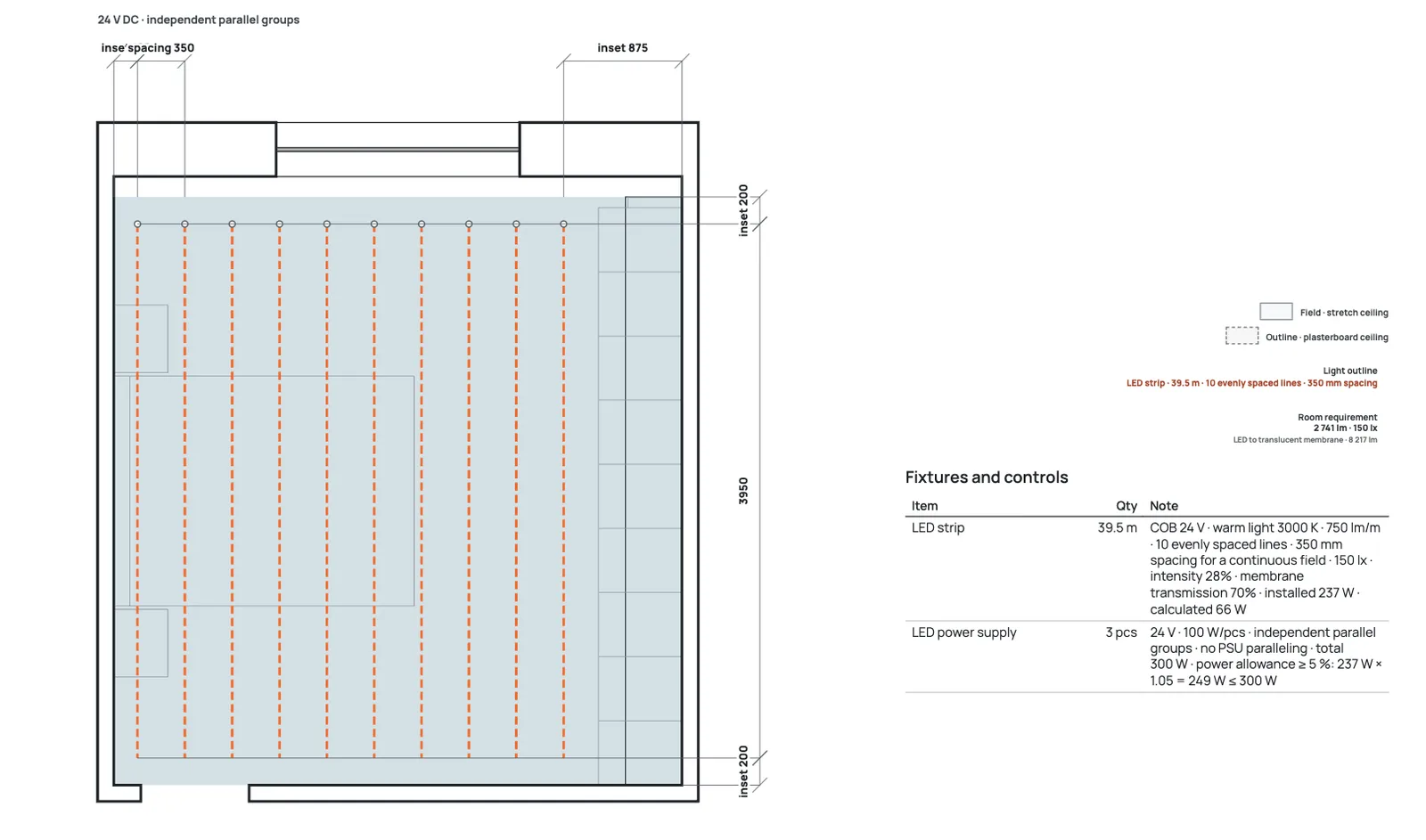 Halo light: strip lines at a 350 mm pitch
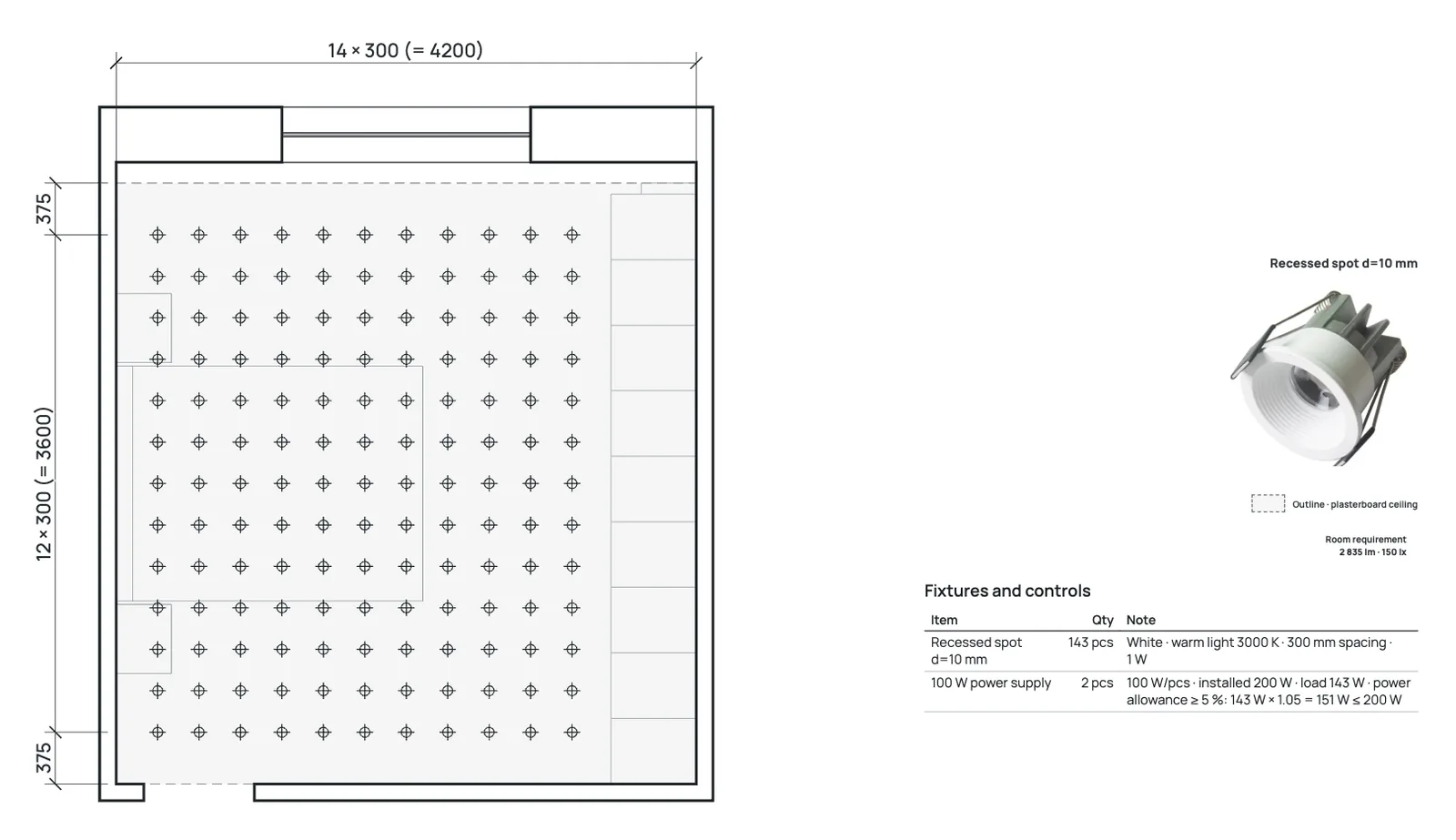 Starry sky: 300 mm spot grid
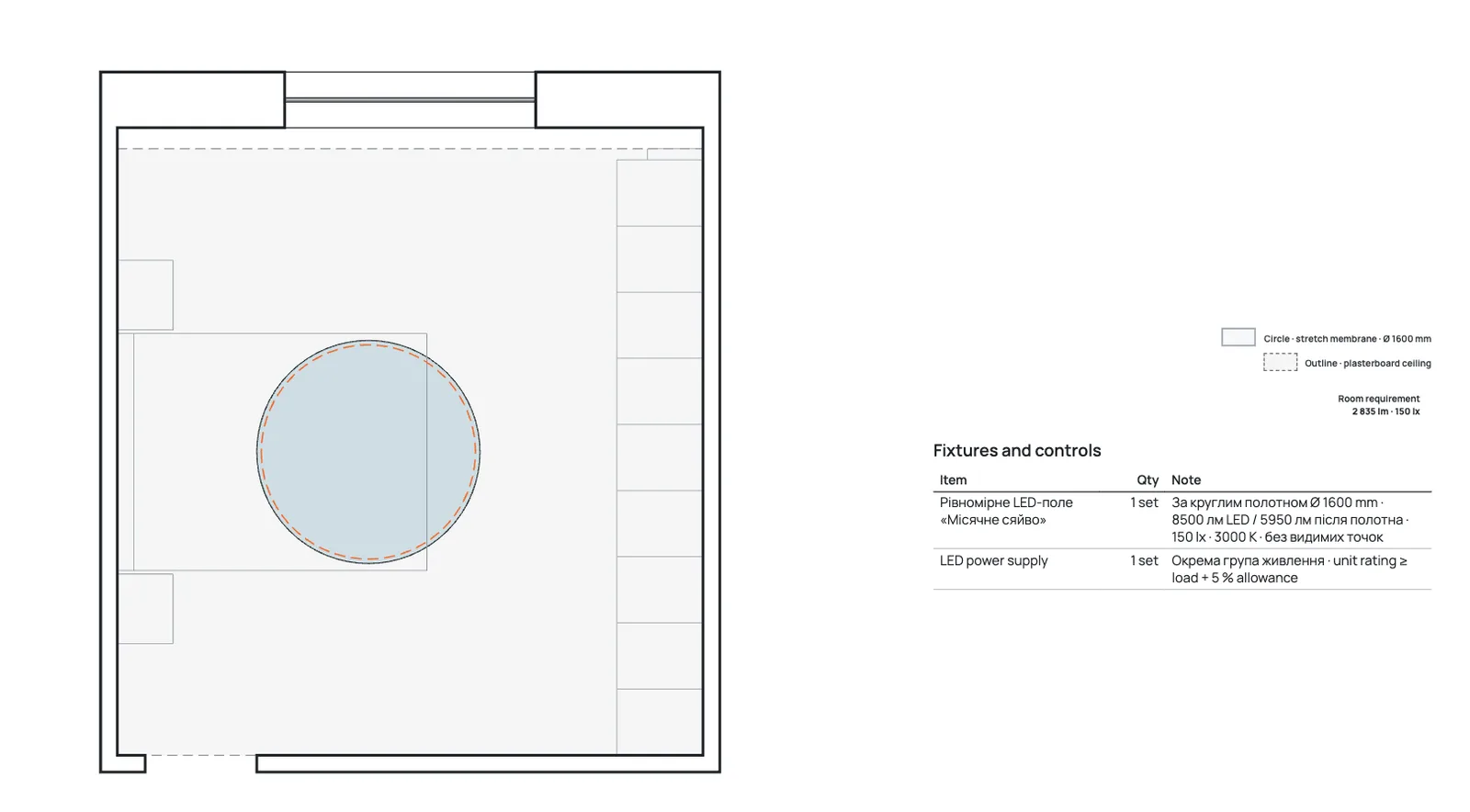 Moonlight: Ø 1600 mm circle
Authored lighting goes into the drawings with pitch, quantity and power, so the crew does not have to invent anything on site.
A chandelier on any ceiling: over the table and at the right height
A chandelier is the most familiar main light and a decoration in its own right; it is available on all three ceilings. You choose where it hangs: “Auto”, “Centre”, “Over table” or “Coffee table”, the last two appearing only when such a table is in the room. If you move the table, the chandelier follows it.
The configurator keeps the ergonomics in check: in a walkway the bottom of the chandelier is no lower than 2 m, and over a table it is at least 55 cm above the tabletop, ideally about 65 cm. The chandelier shop shows only models that fit your room at your ceiling height.
In a bedroom you can add bedside pendants above the bedside tables to the central chandelier. They are shifted slightly towards the bed so the light falls on your book, but they never end up above the mattress. The central and bedside lights switch on separately.
Site manager: On drywall, a heavy chandelier is fixed to the slab, not to the board; on a stretch ceiling, to a mounting plate set before the sheet is stretched.
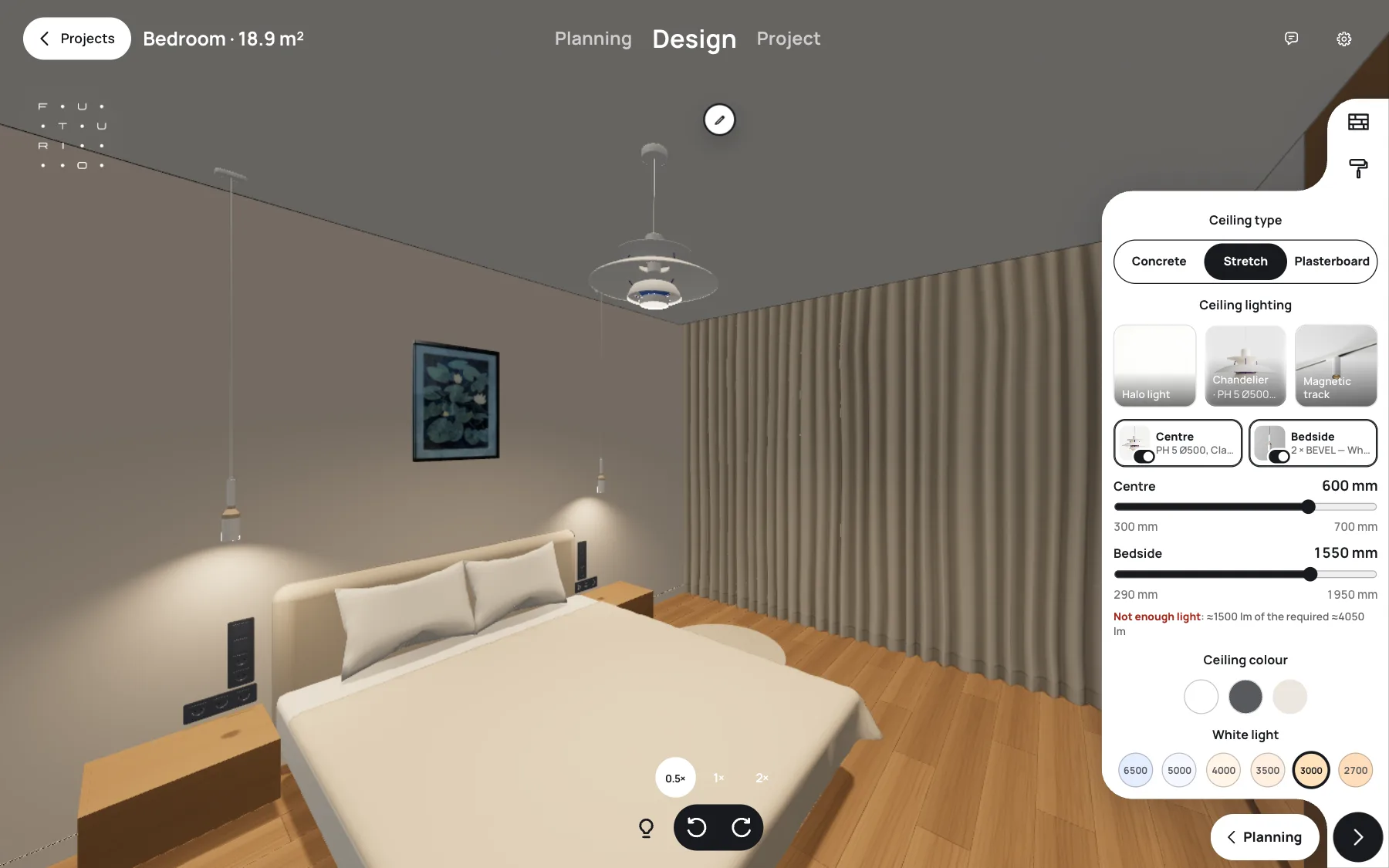
The chandelier is tied to the table, hangs at a verified height, and the shop shows only models that fit.
Magnetic track on any ceiling
A magnetic track is a thin profile running on safe 48 V, into which spots and linear fixtures are slotted. They can be rearranged or replaced at any time without an electrician, so a track copes well with moving furniture around. The mounting depends on the ceiling: surface-mounted on concrete, on a hidden platform under the sheet, flush with the ceiling in drywall, or on cables on any of them.
You choose the layout: one line, two parallel lines, an L-shape or a square around the perimeter. The lines keep 60 cm away from the walls so light falls on furniture and walls from above, and the track avoids wardrobe zones and the swing of their open doors. The light colour is warm 3000 K or neutral 4000 K, and the track and fixtures are white or black.
The lines are assembled from whole profiles of 1, 2 and 3 metres, with no cutting on site. The configurator picks the power supplies, connectors and minimum set of fixtures itself and adds them to the schedule.
Site manager: Put the track’s power supply where you can reach it: in an access hatch, a recess or a wardrobe.
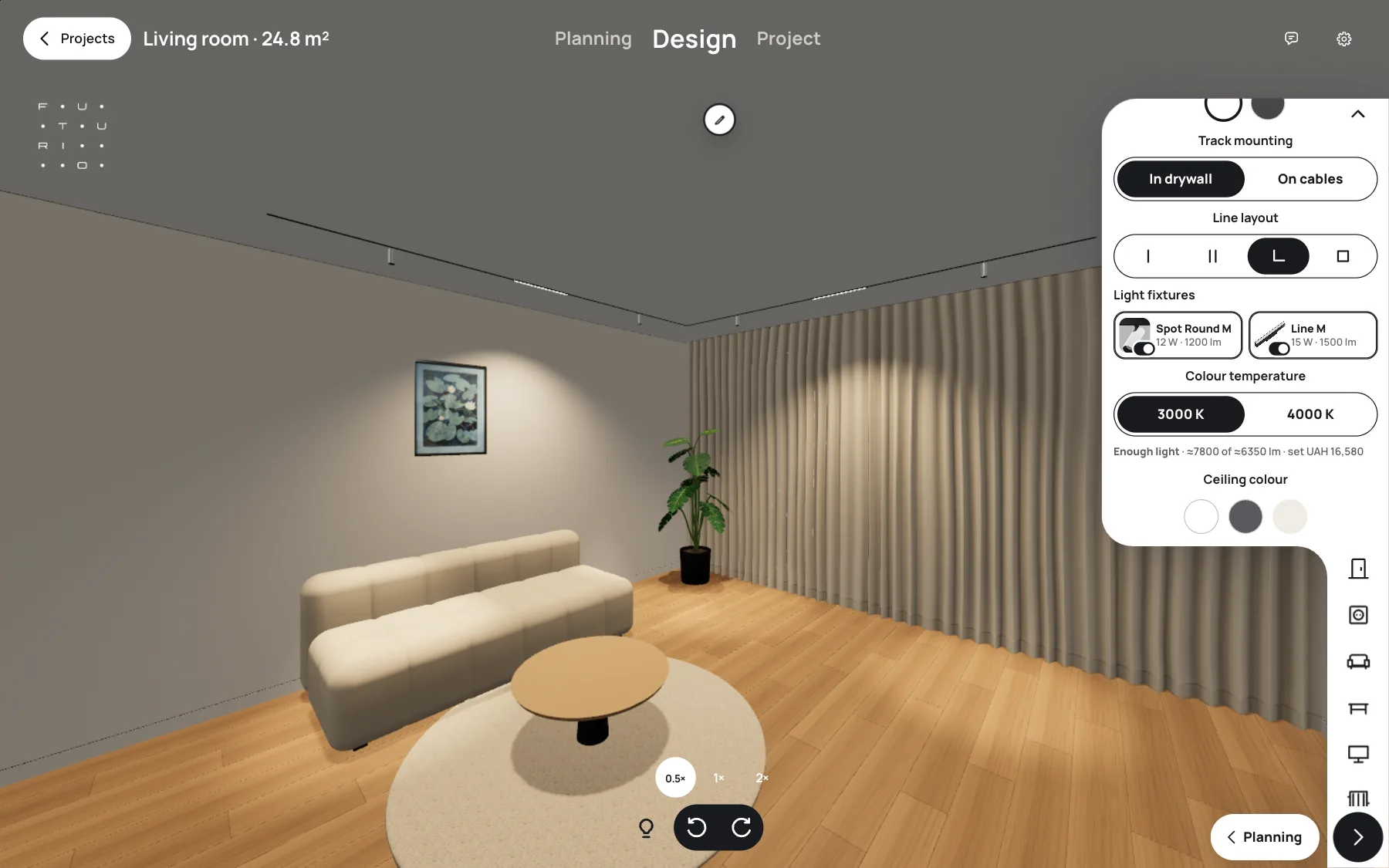
A track works on any ceiling, avoids wardrobes and is assembled from whole profiles.
How to set up the ceiling and lighting in FUTURIO Home
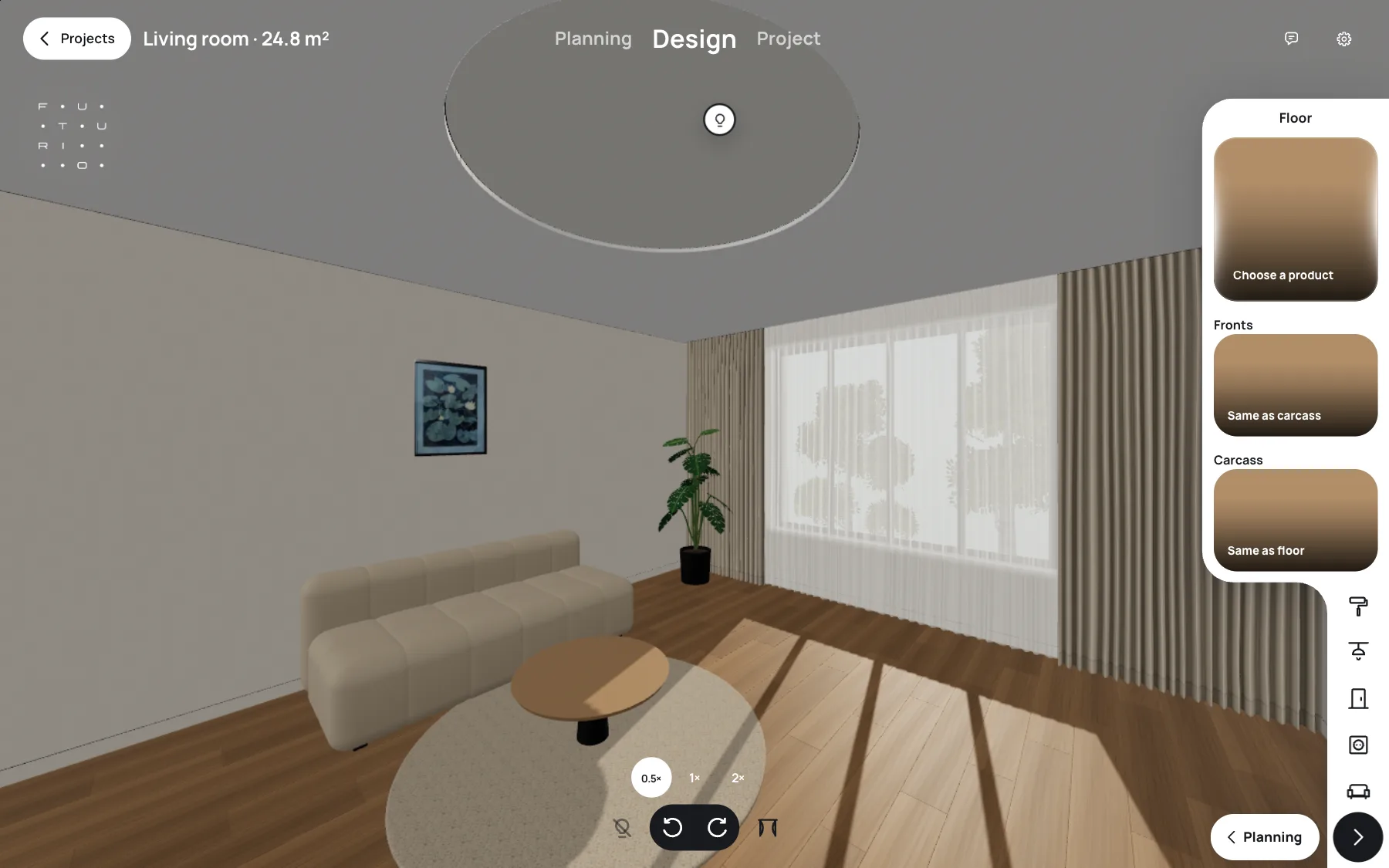
At the “Design” stage, open the “Ceiling” group. First choose the “Ceiling type”: concrete, stretch or drywall. Below, under “Ceiling lighting”, only compatible options remain: for concrete, a chandelier and a magnetic track; for stretch, “Halo light” is added; for drywall, “Starry sky” and “Moonlight”.
Then adjust the chosen lighting: the diameter of “Moonlight”, the “Starry sky” grid, the track layout and mounting, the chandelier’s fixing point and height, the ceiling colour and the light temperature. If you change the ceiling type and the chosen lighting cannot be installed on the new ceiling, the configurator switches it to a compatible one itself. If a chandelier or track physically does not fit, for example into a walkway, above a wardrobe or into the swing of open doors, the change is not accepted and you see an explanation.
For chandeliers and tracks, the configurator estimates whether the light will be enough: it compares the luminous flux of the fixtures with what a room of that area, height and finish colour needs, and shows “Enough light”, “Light is borderline” or “Not enough light”. It is a preliminary estimate, not a lighting design, but it saves you from a beautiful chandelier under which you cannot read in the evening.
You see the result in 3D straight away, and the ceiling and lighting go into the project sheets together with the furniture layout, ready to hand to the crew.
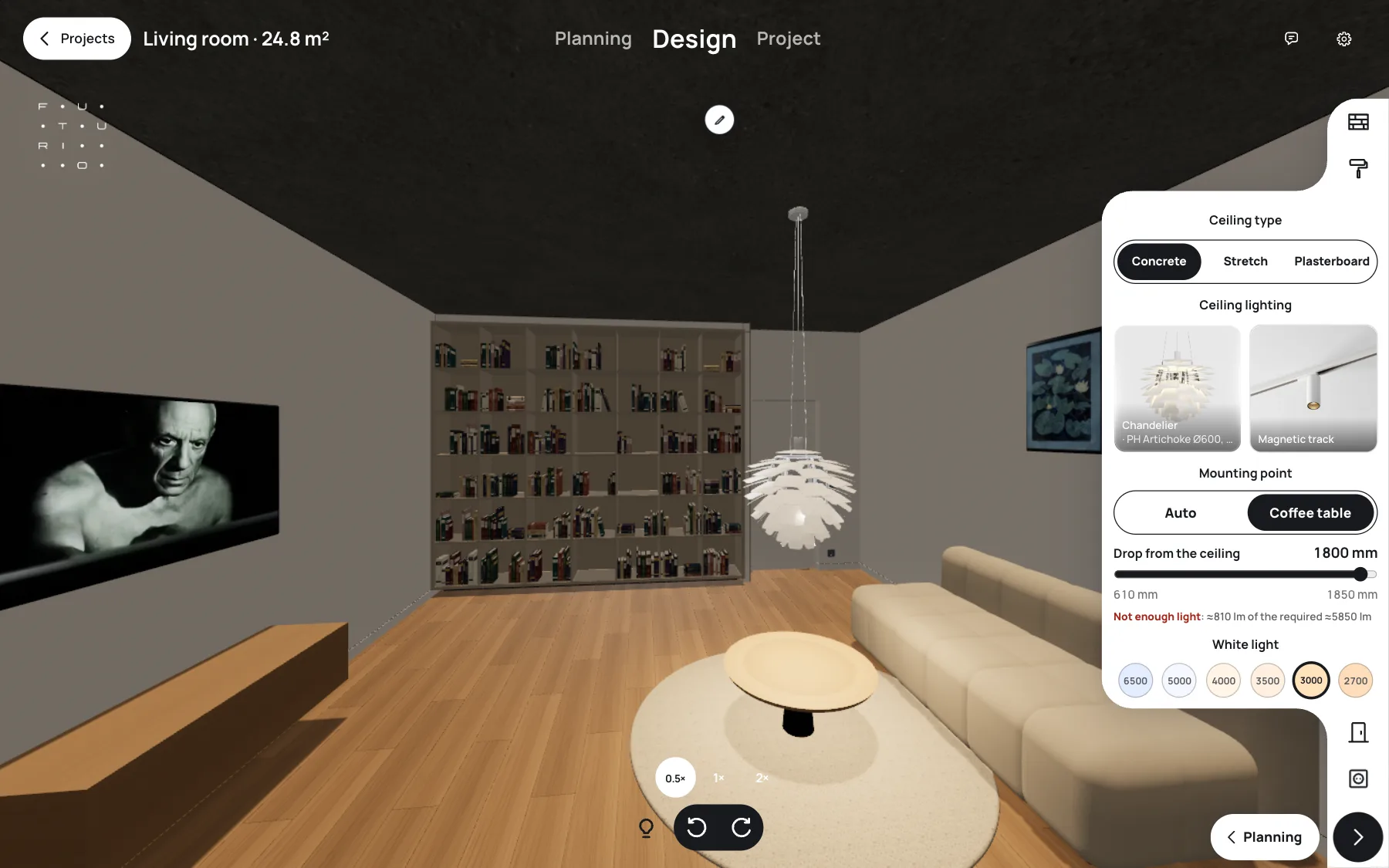
Ceiling type first, then lighting, and every option you see can really be installed.
Frequently asked questions about ceilings and lighting
Which ceiling is best for soundproofing?
Drywall, if you build it as an acoustic system: with mineral wool in the void and vibration-isolating hangers. A stretch ceiling and a bare slab add no soundproofing on their own, and against footsteps from above the best help is a floating screed on the neighbours’ floor.
Are stretch ceilings harmful?
Manufacturers declare quality PVC sheets as phthalate-free with low emissions, and certificates confirm it. Ask the installers for them for the specific sheet, and ventilate the room for the first few days after installation.
Which is cheaper, a stretch or a drywall ceiling?
A single-level stretch ceiling is usually cheaper and faster than painted drywall. But the cost of both is driven by perimeter, amount of lighting, levels and recesses, so compare quotes for your own room.
Can I leave a concrete ceiling bare?
Yes, if the slab is level and you like how it looks. It is cleaned, dedusted and primed, and the lighting, a chandelier or a magnetic track, is fixed to the slab. Cables are routed in advance into chases or surface-mounted channels.
What can I hang in a bedroom instead of a chandelier?
If the ceiling is drywall, look at “Starry sky” or “Moonlight”, FUTURIO’s own ceilings with soft light and no fixtures hanging down. On a stretch ceiling, “Halo light” gives even general light, and you can add bedside pendants for reading.
Can I make a starry sky on a stretch ceiling?
In FUTURIO Home, “Starry sky” and “Moonlight” are offered for a drywall ceiling. For a stretch sheet, “Halo light”, a chandelier and a magnetic track are available.
The easiest way to feel the difference is to switch the ceiling type in your own room and watch how the light changes.
Verdict: choose the ceiling for your priorities, and the lighting for the ceiling
There is no perfect ceiling. Concrete means height and savings, stretch means speed and cleanliness, drywall means quiet, shape and the most lighting options. Decide what matters most to you before the rough work, and then choose lighting for that ceiling: a chandelier or track for everyday use, “Halo light” for even general light, or “Starry sky” and “Moonlight” for atmosphere.
In FUTURIO Home you choose the ceiling type in your own room, see only the compatible lighting, check heights and the amount of light, and the crew gets the ceiling and lighting in the project sheets together with the furniture layout.
Spotted an inaccuracy, or want to suggest a new ceiling or lighting type? Write to us at hello@futurio.ua and we will correct the text.
Pick a ceiling in your own room and see which lighting is possible on it.